
Working at heights
Falls from heights are a primary cause of traumatic injuries and fatalities at NSW workplaces, with most occurring in the construction industry.
Controlling the risk
Work health and safety laws require a PCBU to use the hierarchy of control to manage risks. This means, eliminating the risk where possible. If you can’t eliminate the risk, reduce it through substitution, isolation and engineering controls, before finally considering administrative controls.
WHS laws state you must:
1. Work on the ground or on a solid construction
- If you don’t have to work at heights, don’t. Working from the ground or solid construction is always the safest option.
- A solid construction is a structurally sound area with a flat and stable surface:
- capable of supporting the weight of people and materials
- with fall protection around its perimeter and any other fall hazards
- with a safe means of entry and exit.
2. Provide protection against risk of falls
If you can’t work from the ground or solid construction, you must provide adequate protection against the risk of falls. This includes implementing the following hierarchy of control measures:
a. Use a fall-prevention device
Where reasonably practicable, you must use a fall-prevention device. Examples include scaffolds, elevating work platforms, mast climbing work platforms, work boxes, building maintenance units, perimeter guardrails, and secure fences/barriers/covers.
b. Use a work-positioning system
A work-positioning system can only be considered where it is not reasonably practicable to use a fall-prevention device.
A work positioning system is a harness-based system that either prevents a fall hazard being reached (e.g. total restraint system) or enables a person to work supported in tension (e.g. industrial rope access systems).
c. Use a fall-arrest system
A fall-arrest system can only be used when it is not reasonably practicable to use either a fall-prevention device or a work positioning system.
Fall-arrest systems do not prevent a fall, however, if installed and used properly, they reduce the impact of the fall. Examples include industrial safety nets, catch platforms, and harness-based fall-arrest systems.
If you use a fall arrest system you must have emergency and rescue procedures in place and test them to ensure they are effective.
d. Use other controls
Residual falls risks that aren’t controlled though higher order measures can be minimised using administrative controls. Examples include safe work procedures, safe sequencing of work, safe use of ladders, permit systems, “no go” areas, signs etc.
A combination of the above fall protection and administrative controls may be required if a single control is not sufficient to provide adequate protection against the risk. Many of these controls rely heavily on user competency to be effective. Workers must be trained and have the appropriate skills to carry out their particular task safely.
Additional requirements for construction work
A safe work method statement (SWMS) is required for construction work where a person could fall more than two metres.
A SWMS must be site-specific and made available to workers, supervisors and any other persons at the workplace, so they can understand the hazards, risks and safety controls that must be used.
You can also check off your safety with the Working at heights in construction safety checklist (PDF, 208.69 KB)
Ladders
Each year there are hundreds of serious incidents where workers have fallen from ladders. Many of these incidents involve a ladder being used incorrectly or inappropriately.
A-frame style step ladders
Many workers fall from A-frame style step ladders because they were working from the top two steps, or over-reaching.

Here are some tips.
- don’t stand on the top two steps
- have two feet and one other point of contact on the ladder e.g. hand, waist, torso
- ensure the ladder is rated for industrial use and is in good condition
- ensure all four feet of the ladder are on the ground
- don’t overreach.
Extension ladders
Many falls from extension ladders are because the ladder slipped outwards or sideways.

Here are some tips.
- secure the ladder at the top and bottom, wherever possible
- ensure the ladder extends at least one metre past the landing
- ensure the ladder is rated for industrial use and is maintained in safe working condition
- when ascending or descending, face the ladder, have both hands free to grip the ladder, and have at least one hand and one foot in contact with the ladder at all times
- when working on the ladder, have both feet and one other point of contact on the ladder e.g. hand, waist or torso.
Ladder safety resources
- Toolbox talk: Using ladders in construction
- Guidance: Pocket guide to ladder safety (PDF, 1104.94 KB)
- Poster: Step up your ladder safety (PDF, 2974.31 KB)
Roofs
Falls can happen off the edge of a roof, or through fragile roof materials such as skylights or plastic roof sheeting.

Use:
- for edges: temporary edge protection such as roof guard rails or scaffold
- for fragile roofing: skylight covers, crawl boards, or physically marked exclusion zones.
Temporary edge protection, skylight covers and crawl boards can be re-used on many jobs and are quick and easy to install.

Roof safety resources
- Fact sheet: Roof edge protection
- Video: Work safely on roofs when installing solar panels
Scaffolds
Many scaffold falls occur because the scaffold had inadequate or missing components, such as missing rails or planks, or because it was built with non-compliant gaps.
Only licenced scaffolders can erect, alter or dismantle a scaffold where the risk of a person or object falling is more than 4 metres.
Persons conducting a business or undertaking (PCBU) are responsible for ensuring a scaffold is safe, with no falls risks, for the duration of the build.

Make sure:
- the scaffold is inspected before accepting written confirmation (e.g. handover certificate), to be assured the scaffold is complete, safe and compliant
- the scaffold is inspected at least every 30 days by a competent person
- there is a plan or clear understanding of how/when the scaffold will be modified as the construction project progresses, so that the scaffold remains safe and compliant throughout the build
- workers do not access incomplete sections of the scaffold
- unlicenced workers do not alter the scaffold
- the scaffold is checked every day, before use, to ensure it is adequate for the work that is planned, and there is no risk of falls, falling objects or scaffold collapse.
Scaffold resources
- Toolbox talk: Using scaffolds (PDF, 690.33 KB)
- Checklist: Scaffold management and inspection (PDF, 392.98 KB)
- Standard: Scaffolding Industry Safety Standard to understand how to manage scaffold safety on site.
Trucks and trailers
Many falls from trucks occur when the operator is alighting to or from the cabin, or when loading and unloading the vehicle or trailer.
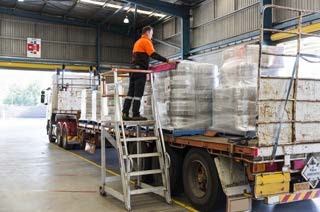
To reduce the risk of injury or death as a result of falling from a height:
- always use three points of contact, face the cabin and use the appropriate grab handles, when getting in and out of the vehicle
- reduce the need to work at heights by pre-configuring loads to facilitate the unloading process, taking into account the equipment to be used
- perform work at ground level and take a ‘working from the ground’ approach when loading and unloading vehicles
- use work platforms, guardrail systems or edge protection, including barriers and handrails, where working from the ground is not possible
- only use work positioning systems (such as travel restraints) where other controls are not reasonably practicable
- use load restraints that can be operated from the ground
- consider the environmental conditions (e.g. severe weather, slippery loads) and their effect on the task you are carrying out.
Mezzanines
Many falls from mezzanines occur because they didn’t have edge protection, there is inadequate access/egress, or if the mezzanine was not designed to be walked on.

If you have a mezzanine, ensure that:
- it is engineered and constructed for the loads handled and stored on it, including any load handling equipment
- there is a structurally-sound and safe means to access the mezzanine
- ladders should not be used if people are required to carry items when accessing and egressing from the mezzanine
- there are structurally-sound safety barriers in place to stop people falling off the edge of the mezzanine. If this is a handrail, use mid rails and toe-boards to prevent items from falling
- gaps in guard rails used for loading/unloading items on the mezzanine are guarded by gates or removable handrails that can be safely removed and replaced, without putting workers at risk of falls.
Formwork
Many falls from formwork occur when there is inadequate edge protection, or inadequate fall protection for penetrations.

Ensure:
For formwork erection and dismantling that there is -
- adequate consultation and communication with principal contractors, site supervisors and formworkers
- adequate planning prior to formwork activities commencing and that the safe systems of work align with the design/plan
- safe work methods, including working from the ground where possible
- exclusion zones to prevent unauthorised access during erection and dismantling.
For those working on formwork there is -
- edge protection and covers to prevent falls over edges or through penetrations
- adequate access and egress to the decks
- workers are adequately trained, instructed and supervised on site safety and safe work systems.
Formwork resources
Checklist: Formwork safety (PDF, 171 KB)
Silos
Many falls from silos occur when inspecting and handling the contained product or maintaining the silo.

To reduce the risk of falls from silos:
- Work from the ground whenever possible by installing and using ground level working devices such as:
- augers and or conveyors to lift the product from the ground or truck level up into the silo
- extension rods and cables to open and close hatches from the ground
- drone technology to conduct high level visual inspections
- sight glasses showing the amount of product in the silo that can be seen from the ground
- access doors and hatches that can be opened and closed from ground level
- fumigation systems that distribute the gas to the head space from ground level.
- If work cannot be performed from the ground, the risk of falls can be reduced by:
- using fixed encaged ladders, having platforms with guard rails fitted to the top of the silo or using an elevated work platform
- ensuring fixed ladders and elevated areas are inaccessible to unauthorised persons including children
- if a fall prevention device cannot be used, a work positioning or fall arrest system such as harnesses with life lines and secure anchor points should be used.
Silos resources
- Webinar: Silo safety - how prepared are you?
- Checklist: Silo’s safety checklist (PDF, 2848.03 KB)
- Video: Silo safety – falls from height
Excavations
Many falls into excavations occur when working near the excavation or attempting to enter or egress the excavation.
Control measures to reduce the risk of falls into excavations include:
- creating physical edge protection by utilising the trench’s support system itself, for example stacking additional trench box extensions or using trench sheets longer than the trench depth
- installing guard rails or covers on trench shields
- inserting guard rails and toe-boards into the ground immediately next to the supported excavation side
- installing landing platforms or scaffold towers inside deep excavations
- securing ladders to trench shields
- installing effective barriers or barricades
- providing clearly defined pedestrian detours
- providing alternative access and egress points to the excavation for emergency use, and
- backfilling the excavation as work progresses.
Safety resources
Industry specific
Construction
- Pocket guide to Construction safety
- Safety checklist: Working at heights in construction safety checklist (PDF, 208.69 KB)
- Safety checklist: Formwork safety (PDF, 171 KB)
- Safety checklist: Earthmoving plant in construction (PDF, 669.46 KB)
- Safety checklist: Scaffold inspection (PDF, 392.98 KB)
- Webinar: Working safely at heights in construction - YouTube
- Web page: Installing rooftop solar panels
Manufacturing, transport and storage
- Guide: Falls in manufacturing (PDF, 1073.84 KB)
- Guide: Safety around your vehicle – Glove box guide (PDF, 1466 KB)
- Guide: Guide to WHS in the road freight transport industry
- Web page: Falls in transport
Agriculture
- The A-Z of Farm Safety PDF, 5673.78 KB
- Horse-related injuries
- Webinar: Silo safety - how prepared are you?
- Safety alert: Harvesting at heights
Codes of Practice
- Managing the risk of falls at workplaces (PDF, 2326.56 KB)
- Managing the risk of falls in housing construction (PDF, 2296.79 KB)
- Excavation work (PDF, 4128.95 KB)
Translated resources
Search for translated resources for key languages in NSW.
Research and evaluations
- Regulators options paper: Reducing falls from heights in the construction industry - June 2023 options paper (PDF, 1427.25 KB)
- Evaluations of various SafeWork NSW initiatives and safety activities, including work at heights
Legal obligations
There are specific laws about working safely at heights: See selections 78 – 80 of the Work Health and Safety Regulation 2025.
There are also general work health and safety laws that will apply to you in any situation, including when working at heights.