
Hospitals
This page is about the risks hospital workers face and provides resources about how to prevent injuries from occurring.
The hospital sector includes workers who provide care and physical assistance to patients in a public or private hospital setting.
The risks
Hospital workers face many risks in the workplace, including:
- muscular stress from hazardous manual tasks and patient handling
- slips, trips and falls
- workplace violence and aggression
- psychosocial hazards where aspects of the job, including role overload, low job control, conflict or poor workplace relationships and bullying, can cause a stress response.
These hazards may also impact security staff, kitchen workers, laundry workers, cleaners, and administration staff.
Resources
The following resources help employers and workers identify hazards in the workplace and prevent injuries from occurring.
WHS responsibilities in hospitals
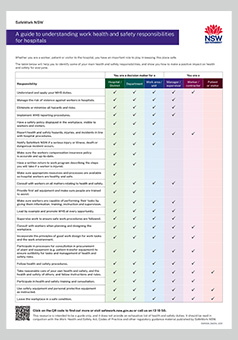
Whether you're a worker, manager, patient, or visitor, you have an important role to play in keeping a hospital safe.
SafeWork NSW has produced a poster to display in your hospital (pictured) to help promote work health and safety.
The poster outlines the responsibilities for:
- decision makers
- managers and supervisors
- workers and contractors
- patients and visitors.
It will help stakeholders quickly identify their role in making a positive impact on health and safety for everyone.
Download the poster (PDF, 137.75 KB)
View the accessible version of the WHS responsibilities poster
Responsibilities of hospital staff
All workers and contractors must:
- understand and apply their WHS duties. For more details, see Legal obligations.
- report health and safety hazards, injuries, and incidents in line with hospital procedures
- participate in processes for consultation in procurement of plant and equipment (e.g. patient transfer equipment) to ensure suitability for tasks and management of health and safety risks
- follow health and safety procedures
- take reasonable care of your own health and safety, and the health and safety of others, and follow instructions and rules.
- participate in health and safety training and consultation
- use safety equipment and personal protective equipment (PPE) as instructed. For more details, see PPE.
- leave the workplace in safe condition.
Responsibilities of decision makers and managers
In addition to the responsibilities above, if you are in a leadership position in a hospital you have extra duties. This includes managers and supervisors, as well as decision makers at the following levels:
- hospital/district
- department
- work area/unit.
Decision makers and managers/supervisors must:
- manage the risk of violence against workers in hospitals. For more details, read the Code of Practice: Managing psychosocial hazards at work and the guide to preventing and responding to work-related violence (PDF, 275.95 KB).
- eliminate or minimise all hazards and risks. For more details, read the Code of practice: How to manage work health and safety risks (PDF, 556.72 KB).
- implement WHS reporting procedures. For more details, see Reporting.
- consult with workers on all matters relating to health and safety. For more details, read the Code of Practice: Work health and safety consultation, cooperation and coordination (PDF, 635.62 KB).
- Make sure workers can perform their tasks by giving them information, training, induction and supervision. For more details, read worker capability.
- lead by example and promote WHS at every opportunity
- supervise work to ensure safe work procedures are followed
- consult with workers when planning and designing the workplace. For more details, see Good work design.
- incorporate the principles of good work design for work tasks and the work environment.
Decision makers must also notify SafeWork NSW if a serious injury or illness, death or dangerous incident occurs. For more details, see Incident notification.
Senior decision makers (hospital, district, and department level) have more responsibilities. They must:
- make sure the workers compensation insurance policy is accurate and up to date. For more details see Workers compensation and recovery at work
- have a written return to work program describing the steps you will take if a worker is injured. For more details see Workers compensation and recovery at work
- provide first aid equipment and make sure people are trained to assist. For more details, see Code of Practice: First aid in the workplace (PDF, 391.59 KB).
If you’re senior decision maker at the hospital or district level, you must also ensure appropriate resources and processes are available, so hospital workers are healthy and safe. For more details, see Code of Practice: How to manage work health and safety risks (PDF, 556.72 KB).
Responsibilities of patients and visitors
Patients and visitors must:
- take reasonable care of your own health and safety, and the health and safety of others, and follow instructions and rules.
- use safety equipment and personal protective equipment (PPE) as instructed. For more details, see PPE.
- leave the workplace in safe condition.
Moving and handling people
The WorkSafe Victoria handbook moving and handling people in the healthcare industry is for workers who handle patients, residents and clients.
Managing psychosocial hazards
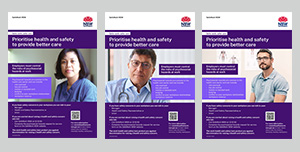
Display these posters in your workplace to help educate staff about psychosocial hazards and where to get help. Click on the links to download.
- Allied health professionals (PDF, 203.61 KB)
- General practitioners (PDF, 193.63 KB)
- Nurses (PDF, 173.3 KB)
SafeWork NSW has also developed the Code of Practice for Managing psychosocial hazards at work.
If you're experiencing bullying or other psychosocial hazards in your workplace you may raise the issue with SafeWork NSW by completing our request for service form. We can help within the scope of our legislative responsibilities.
Read about how we can help or call us on 13 10 50 for more information.
Contact SafeWork NSW to arrange a workplace visit by one of our trained Inspectors. Our Inspector will conduct a hazard identification inspection with your workers and managers, and recommend changes to existing practices or the work environment to reduce the risk of injury.
Systems thinking toolkit
Systems thinking is a way of thinking about the world that helps us better understand and improve outcomes in complex systems.
Find out more about systems thinking by watching this introductory video.
These resources provide practical steps and guidance on how to apply systems thinking to address work-related violence (WRV) in hospitals.
Download an overview of systems thinking for preventing WRV in hospitals (PDF, 168.66 KB).
Multi-level risk assessment toolkit
Provides guidance on managing risks associated with WRV from a system perspective, with tools for stakeholders at various system levels.
- Multi-level risk assessment toolkit (PDF, 560.37 KB)
- Healthcare organisation level risk assessment tool (PDF, 165.79 KB)
- Hospital facility risk assessment tool (PDF, 168.54 KB)
- Department level risk assessment tool (PDF, 157.33 KB)
- Department level risk assessment form (PDF, 281.15 KB)
- Preventing work related violence in NSW hospitals poster (PDF, 49.88 KB)
- Working together to prevent violence in NSW hospitals poster (PDF, 58.61 KB)
Preventing work-related violence systems thinking in incident investigations guide
Download the guide (PDF, 457.77 KB).
Reporting culture improvement roadmap
Download the roadmap (PDF, 209.52 KB).
Read more about how these resources were developed below.
Hazardous chemicals
Exposure to chemicals is 100% preventable. Without the proper controls chemical exposure can cause cancer, respiratory illnesses, skin and eye irritations, as well as fire and explosion-related injuries. In a hospital setting some examples of hazardous chemicals include formaldehyde and cytotoxic drugs.
Our Hazardous Chemicals Code of Practice (PDF, 1171.43 KB) can help you manage hazardous chemicals in the workplace.
Information about clinical handling of cytotoxic drugs and related waste is available in our cytotoxic drugs and related waste risk management guide (PDF, 2798.43 KB).
Action Against Violence in NSW Hospitals Working Group
SafeWork NSW facilitated a systems-thinking project in response to the increasing incidence of work-related violence in NSW hospitals. Following this project, the Action Against Violence in NSW Hospitals Working Group was formed. Read the final report from the project.
The Working Group includes representatives from:
- the NSW Ministry of Health
- NSW Local Health Districts
- unions (members of Health Services Union, NSW Nurses and Midwives Association, Australian Salaried Medical Officers Federation)
- NSW Ambulance
- NSW Police
- private hospitals (Healthscope Operations, Ramsay Health Care, Healthe Care)
- Justice Health and Forensic Mental Health Network
- SafeWork NSW.
The Working Group will develop strategies, priorities and initiatives to address work-related violence in NSW hospitals. PCBUs should put these strategies, priorities and initiatives in place.
The Working Group aims to:
- influence policy and decision-makers
- promote and communicate key messages to stakeholders and the community
- act as advocates for driving change, and
- promote and advocate for safer work, safer care in the health care sector.
Download the work plan (PDF, 63.73 KB) that will guide the Working Group to December 2023.
Work-related violence
Work-related violence (WRV) is a complex and growing issue. It can cause personal, societal and economic harm. In hospitals, WRV is a significant risk to the health and safety of workers, patients and visitors.
SafeWork NSW commissioned the Centre for Human Factors and Sociotechnical Systems (CHFSS) at the University of the Sunshine Coast to develop evidence-based resources and case studies to build capability within hospitals to use systems thinking for the prevention of WRV.
Systems thinking toolkit
The Working Group chose three tools to be developed by CFHSS. Once the tools were created, CFHSS delivered stakeholder workshops to test the content and utility of the resources in practice. You can access the resources above.
Prevention and Management of Violence in NSW Hospitals Showcase
In December 2023 the Prevention and Management of Violence in NSW Hospitals Showcase was held at NSW Parliament House. This showcase raised awareness of the impact of violence in NSW hospitals, and provided an opportunity for industry, government, and worker representatives to come together to share stories, insights and commit to continuing to work together to address this complex issue.
The Action Against Violence in NSW Hospitals Working Group committed to continue working together to address work related violence in NSW hospitals.
Enforceable undertakings in the hospital sector
An enforceable undertaking is a legally binding agreement between us and the person who proposed the undertaking.
The person is obliged to carry out the specific activities outlined in the undertaking. The activities may be substantial.
Read more about a recent enforceable undertaking in the sector:
Safety information for your sector
This section is relevant to all people who work in the Health Care and Social Assistance sector. You will find information related to:
- Managing harms
- SafeWork NSW activities and commitment
- When to notify SafeWork NSW
- Codes of practice and your legal obligations
- Translated resources
- Manager's toolkit
- Related information
Managing harms
The nature of the work in this sector presents specific hazards for workers. It is important you know what the hazards are in your workplace so you can assess the risks they pose.
Find a list of common hazards and learn how to manage the risks below.
SafeWork NSW activities and commitment
Read about what SafeWork NSW is doing to prevent injury and improve health outcomes:
- Our commitment to the health care and social assistance sector, including our action plan to 2025.
- Project Report September 2020 (PDF, 104.87 KB)
When to notify SafeWork NSW
If there is a serious injury, illness, dangerous incident, or death relating to staff, customers or visitors to your worksite or your place of employment (even if it's off-site), you must report it to us immediately.
Incidents can be notified 24 hours a day, 7 days a week by calling 13 10 50. If you're unsure of whether to notify, use Safe Work Australia's Incident notification information sheet to help you decide. Read more about notifying SafeWork NSW.
Codes of practice and your legal obligations
Hazardous chemicals
Exposure to chemicals is 100% preventable. Without the proper controls chemical exposure can cause cancer, respiratory illnesses, skin and eye irritations, as well as fire and explosion-related injuries.
Our Hazardous Chemicals Code of Practice (PDF, 1171.43 KB) to help you manage hazardous chemicals in the workplace.
Manual tasks
For many businesses, manual tasks are an important part of getting the job done. Some of these tasks can be hazardous and are often the most common cause of workplace injuries.
Our Hazardous manual tasks Code of Practice (PDF, 1499.23 KB) can help you create a safer work environment.
Psychosocial hazards at work
NSW businesses need to manage exposure to psychosocial hazards and risks to psychological and physical health and safety at work.
Our Managing psychosocial hazards at work code of practice can help you manage psychosocial hazards at work.
Managing the work environment and facilities (remote and isolated work)
Download SafeWork NSW's Code of Practice for Managing the work environment and facilities (PDF, 422.29 KB).
Translated resources
There is a range of support and information available to you if you’re faced with a difficult situation at work.
The getting support at work pocket guide (PDF, 182.07 KB) is your starting point to finding the support you need. It is available in the following languages:
- Arabic (PDF, 412.26 KB)
- Simplified Chinese (PDF, 566.21 KB)
- Filipino (PDF, 377.89 KB)
- Hindi (PDF, 430.55 KB)
- Nepali (PDF, 430.56 KB)
Visit our translated resources hub for other print, web and multimedia resources.
Manager’s toolkit
The WHS Manager's Toolkit provides the health care and social assistance sector with key resources to help them manage health and safety in their .