
Operator roles
Nominated wood-chipper operator (NWCO)
There should be a nominated person that is competent in the safe operation of the wood-chipper and set up of the work site. This includes:
- site hazard identification and hazard control
- ensuring the relevant procedures are followed
- setting up public exclusion zones if required
- setting up the machine’s danger zone
- use of the machine and ensuring no foreign debris enters the danger zone
- ensuring the wood-chipper is not left unattended while in operation.7
- during normal work breaks the machine should be shut down and the NWCO ensure the machine is safe and cannot be used.
- site clean-up and equipment pack up
- leaving the site after the work has been completed.
Note: Refer to ‘Site set-up’ and ‘Pre-start checks’ in the Work site section below.
It is expected the NWCO will remain in close proximity (within 1m) to the operator control device and the bump bar at all times during the machine’s operation.Workers
Workers operating wood-chippers can also become entangled while standing beside or in front of the in-feed chute, or while they are feeding material into the wood-chipper.8
If ropes, clothing, or gloves are caught on a branch being fed into the wood-chipper, the worker can be dragged into the danger zone, past the safety curtain and the in-feed rollers onto the cutting blades.9
Ensure operating teams have at least two people who are competent in the use of wood-chipping machines and have received specific training on the individual machine being used.10 One person should oversee the operator control device and the other feed the branches into the machine.
Danger zone
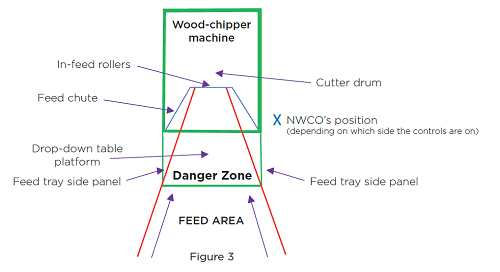
The danger area extends out from the in-feed rollers (see Figure 3). It incorporates the wood-chipper’s feed chute and area of the drop down table. The danger zone stops at the outer edge of the drop-down table and the bump bar.
Feed area
Workers outside the danger zone may still be at risk if ropes become entangled.
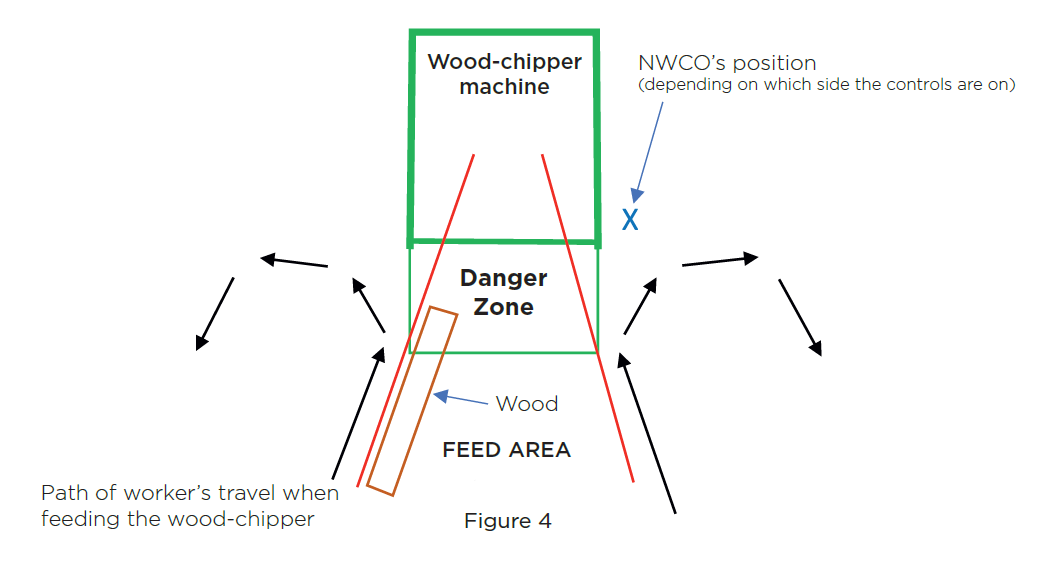
The shape of the feed chute extends the feed area (see Figure 4). The feed area is extended out from the danger zone as shown by the red lines out from in-feed edge of the drop-down table.
Feeding branches and brush into the chute of the wood-chipper should be done from the side of the drop-down table and not from the front of the drop-down table.
Wood can be thrown back and may kick sideways. The NWCO should ensure workers are outside the line of the feed area. If the wood kicks sideways or rolls it should only go as far as the side panel of the drop-down table allows.
The NWCO must stop the machine if the feed area is breached by a worker at any time. They must then ensure the worker has moved safely outside the feed area before the machine is re-started.
This should be considered when doing risk assessments and writing operation or work procedures.
The NWCO must stop the machine if the feed area is breached by a worker at any time. They must then ensure the worker has moved safely outside the feed area before the machine is re-started.
This should be considered when doing risk assessments and writing operation or work procedures.
Back to top