
Operator control devices
An emergency stop or emergency shut-off device should be provided. This device should immediately stop the in-feed rollers and cut the power to the cutting disc or drum (which will typically have a run-down time).
The device should be immediately accessible to the operators in an emergency and tested and verified to be functioning properly during the pre-start check each time the wood-chipper is used.
The operator control bar (Figure 2) is used to set the rotation of the in-feed rollers from feed to reverse. The operating positions should be clearly identified showing the four stages of operation – reverse, neutral/stop, feed, and reverse.
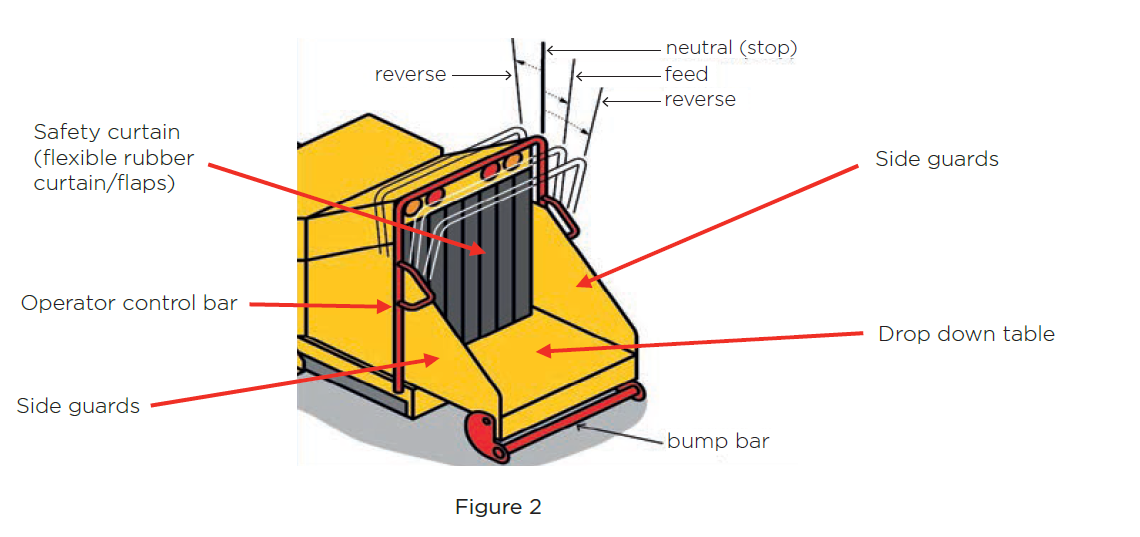
On wood-chippers where the tray of the in-feed chute is less than 600 mm high, consideration should also be given to fitting side in-feed stop control bars that have the same function as the bump bar devices and are also activated by limb or body pressure.
Wood-chippers that are not fitted with an in-feed stop control device, or where the tray of the in-feed chute is less than 600 mm high, should be operated by two operators to ensure unhindered access to the emergency stop button.5
The two operators are the nominated wood-chipper operator (NWCO) feeder and the second worker/feeder. No worker should be able to come close to the in-feed rollers at any time.
If a worker comes close to the front of the drop down table or in-feed chute while the machine is in operation, the NWCO should be able to stop the rollers before this point has been reached and/or before it is breached by the worker.
Bump bars
For extra protection, you may consider retrofitting existing wood-chippers with an in-feed stop control device also known as a push bar or bump bar, along the bottom leading edge of the in-feed chute. This device should stop the in-feed rollers when body pressure pushes against the bar.
Consult with the wood-chipper manufacturer about retrofitting their product.
Bump bars should be painted the standard red colour as required in the Work Health and Safety Regulation.
Drop-down table
The drop down table is fitted to the in-feed area of the wood-chipper to increase the distance between the worker and the in-feed rollers. The bump bar should be fitted under the leading edge of the table as an added precaution.
The side panels or guards fitted on each side of the drop down table protect the workers and limits the side movement, kicking or roll over of any wood being processed.
Safety curtain
Some wood-chippers have a rubber curtain fitted to the front of the in-feed chute (see Figure 2). It is made of reinforced rubber strips that span the opening of the chute.
The safety curtain may reduce the wood chips being thrown out of the wood-chipper and hitting nearby workers. It is also an operator warning to keep hands away from the in-feed chute.
The NWCO should be able to stop the machine before this point has been reached and/or before it is breached by the worker.
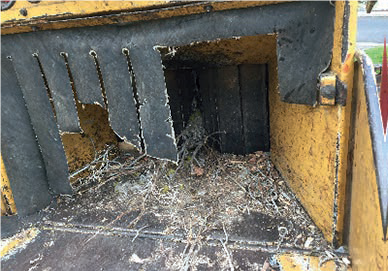
Safety curtains can limit the view of the operator to ensure the rollers are grabbing the wood correctly.
If the wood-chipper has been fitted with a safety curtain, the curtain needs to be maintained and replaced when cut or damaged.
Last chance stops
The business (or other PCBU) should have effective safety systems in place when using these machines.
Last chance stops will stop the in-feed rollers of the machine when pulled. Some machines might have these fitted.
If the worker breaches the defined danger zone, there should be adequate safe-guards in place so they do not reach the in-feed rollers.
Last chance stops might not be an effective option on their own as they require the worker to physically pull a rope. If the worker is entangled their hands or arms might not be free to activate them.
Presence-sensing safeguard system
Work Health and Safety Regulation 2025 section 208:
(2) The person with management or control of the plant must ensure that—
(d) if it is not reasonably practicable to use guarding referred to in paragraph (a), (b) or (c) - the guarding includes a presence-sensing safeguarding system that eliminates any risk arising from the area of the plant requiring guarding while a person or any part of a person is in the area being guarded.
Presence-sensing safeguard system technology could also help prevent a worker coming in contact with the in-feed rollers. These types of safeguards include magnetic sensors that can be worn by operators and/or placed on operating equipment e.g. ropes.
Presence-sensing safeguard systems are incorporated into the design of some models of wood-chippers or can be fitted post-manufacture. They should be fitted and tested by the manufacturer or by a competent person before the machine is used.
Think about these control measures when purchasing a wood-chipper or retrofitting such control measures when undertaking a risk assessment on an existing machine.
All safety devices that are fitted to the wood-chipper should be regularly checked and test results should be recorded. Any identified faults should be raised with the business (or other PCBU) immediately so that repair and/or replacement of those parts can be done before the machine is used.
Winches
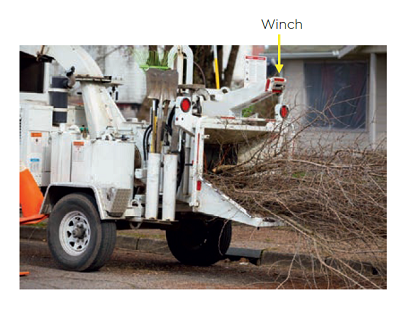
A woodchipper with a winch.
- be trained in the correct operation of the winch on each specific machine
- maintain any ropes that form part of the winch and ensure the ropes are checked for suitability on a regular basis6
- ensure ropes and chains do not make contact with the in-feed rollers
- ensure workers receive training in the correct way to hook the rope or chain to the wood.