
Traffic management
Traffic management
Whenever vehicles, mobile plant (such as forklifts) and pedestrian traffic interact; there is the increased potential for injury or death if traffic management arrangements are not in place or are inadequate.
A person hit by a forklift, moving vehicle or a shifting load will likely suffer serious injury or possibly death.
If you or your workers are involved in loading and unloading activities in the workplace you are most at risk.
Contractors and visitors to your workplace may also be at risk if traffic management systems are poor.
See the Incident Information Release to understand what can occur.
Effective traffic management procedures should be developed to suit the unique requirements of each individual workplace.
The nature of the workplace can determine not only the type and effectiveness of control measures that can be implemented, but also how often these control measures should be reviewed to ensure that they remain effective. These plans and procedures should be made available for contractors and be part of induction to site.
- Safe Work Australia has information on developing and implementing traffic management plans.
- SafeWork NSW has a traffic management guide for truck drivers.
- SafeWork NSW has a safety alert working with or around mobile plant.
Traffic control work training
On 1 July 2020, completion of Traffic Control Work Training (TCWT) became a requirement under the Work Health and Safety Regulation. This means that workers in varying industries such as manufacturing, retail and construction will now be required to obtain a TCWT card.
Examples:
- a supermarket with a loading dock that is accessed via a public road. The supermarket worker will be required to hold a TCWT card to be able to direct traffic to allow the truck to reverse into the loading dock
- a worker may be required to hold a TCWT card on a construction site where vehicles/trucks are accessing via a public road and traffic is needed to be stopped to allow vehicles in and out of the site.
A worker cannot be directed to undertake traffic control work without the appropriate TCWT card. You must ensure that the worker has been recently trained (in the last two years) if they have not undertaken any traffic control work during that period. You should also check that they have an issued TCWT card. Check a NSW-issued licence.
For the specific laws about traffic control work training obligations, see sections 184A - 184N of the Work Health and Safety Regulation 2017.
There are also general work health and safety laws that will apply to you in any situation, including when supporting licensed workers.
Manage traffic management risks
Several business operators may be involved in loading/unloading freight in the workplace such as:
- the transport operator
- the business where the freight is loaded/unloaded
- businesses that control mobile plant at the workplace.
Under work health and safety legislation, each business shares the responsibility for the health and safety of those involved in the work, and the health and safety of others (e.g. pedestrians) who may be in the vicinity of the work. This duty is to the extent of their ability to influence and control the work. You must work together to ensure risks are eliminated, or if this is not possible, minimised.
Separation of vehicles and people
Every workplace is different and will present different hazards and risks.
The most effective way of ensuring persons and vehicles move safely around a workplace is to provide separate pedestrian and vehicle traffic routes.
Ideally, the barriers used to separate people from plant will be permanently fixed, difficult to defeat and will be constructed to ensure all persons are protected. Where possible and practicable, introduce a one-way system as this will minimise the need for vehicles to reverse, and will help pedestrians and drivers.
Your circumstances might mean complete separation of vehicles and people is not possible or practicable. You may minimise the risks by:
- using presence sensing devices fitted to vehicles whereby the vehicle movement and speed is automatically controlled in the presence of pedestrians
- installing gates or temporary barriers to separate vehicles from people
- organising work and times so persons and vehicles are not in the same area at the same time
- supplying separate entrances and exits for vehicles where possible
- installing mirrors and vision panels in pedestrian doors entering vehicle areas
- installing dropped kerbs, barriers, deterrent paving/tactile surfaces to clearly delineate crossing points where vehicles and people cross
- establishing exclusion zones and safety zones like forklift-only areas in loading bays or pedestrian-only areas in the vicinity of places like offices and amenities and their entrances
- locating delivery areas away from pedestrians or work activities
- clearly marking vehicle areas with signs or reflective paint to warn pedestrians
- clearly marking pedestrian walkways and crossings with paint or bollards
- ensuring adequate lighting is installed around entrances, driveways, pedestrian walkways, and vehicle access points
- installing stairs, ramps or walkways for pedestrians and drivers, away from the loading/unloading area
- using signs for speed limits, hazards (like forklift operating areas) and exclusion zones
- ensuring traffic areas and loading/unloading areas are well lit
- ensuring workers wear high visibility clothing
- ensuring vehicles are fitted with warning devices e.g. flashing lights, audible reversing alarm
- installing non-slip surfaces for pedestrians
- providing adequate instructions to drivers on traffic management plans, exclusion zones and site-specific rules for delivery and pickup locations.
Operation of forklifts
Ensure forklift operators are appropriately instructed, trained, supervised and hold a current high-risk work licence for forklifts.
Refer to the forklifts page for various fact sheets, guides and posters you can download.
Traffic routes
It is important to select the most appropriate control as implementing the wrong control measure can increase the risk, for example, reducing vehicle stability.
The general principles for safe traffic routes within the workplace are as follows:
- eliminate the need for vehicles to reverse as much as possible
- make sure they are wide enough for the safe movement of the largest vehicle
- ensure surfaces are suitable and maintained for the vehicles and pedestrians using them
- avoid steep slopes
- avoid sharp corners and blind bends
- keep them clear of obstructions
- ensure they are clearly marked and signposted
- reducing vehicle speed and installing traffic control measures such as speed humps, chicanes and ‘rumble strips’ can reduce vehicle speed
- speed limits need to be appropriate, properly enforced and, where possible, consistent across the site
- to assess a suitable speed limit, consider the route layout and its usage. For example, lower speeds will be appropriate where pedestrians are present or where forklifts and vehicles share a traffic route.
Visibility in the workplace
Work areas should be suitably lit for drivers to see hazards and persons to see vehicles in the workplace.
Good visibility for drivers relates to vehicle speed and the distance required to stop or change direction safely.
Install mirrors where sharp or blind bends are found on traffic routes.
Lighting in the workplace
The workplace should have suitable and sufficient lighting in work areas where:
- vehicles manoeuvre or pedestrians and vehicles circulate and cross
- loading and unloading take place.
Provide levels of light to ensure there are no drastic and sudden changes that could lead to drivers being dazzled. For example, consider the time of day and sunlight.
Reversing of vehicles in the workplace
The most effective way of reducing reversing incidents in the workplace is to remove the need to reverse by introducing one-way systems wherever possible.
Where reversing is necessary and unavoidable, consider the following:
- installing suitable barriers to prevent vehicles from entering pedestrian zones
- identifying and clearly marking designated reversing areas
- restricting people from entering reversing areas and operations
- using appropriate and suitable communication systems
- installing equipment on vehicles to help the driver and pedestrians, such as reversing alarms, flashing lights and proximity-sensing devices.
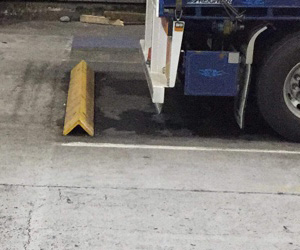
Truck wheel stops can be installed and designed to withstand the weight of heavy vehicles and mobile equipment while driving and reversing into parking areas, loading and unloading.