
High rainfall and flash flooding warning for quad bike, side-by-side vehicle (SSV) and tractor operators
High rainfall and flash flooding significantly impact ground conditions for quad bikes, SSVs and tractors. Operating these vehicles beyond their limitations can significantly increase the risk of severe injury or death.

Emergency details
- In life-threatening emergencies call 000 from fixed or mobile phones.
- Call 112 from GSM mobile phones only – a signal is necessary. The call automatically directs to 000.
- Two-way radio, either UHF or CB – UHF channel 5 is established for use by anyone, but only in an emergency situation.
- If you require assistance due to flood, storm and tsunami emergencies, please phone NSW SES on 132 500.
Take extra care in wet weather
- Keep up to date with the weather forecast and any warnings issued by the Bureau of Meteorology and NSW SES.
- Plan the safest route and take extra care – high rain fall means visibility will be low and ground conditions will likely be impacted.
- Avoid using vehicles and farm equipment if there is a likelihood of it becoming bogged.
- Watch the ground ahead for potential hazards:
- Look out for holes, wash outs, pooling water in long grass, fallen branches and other obstacles.
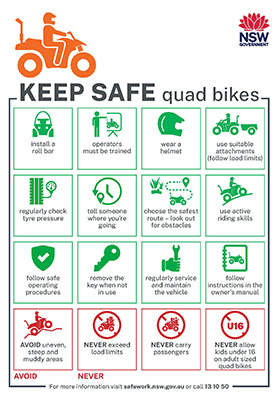
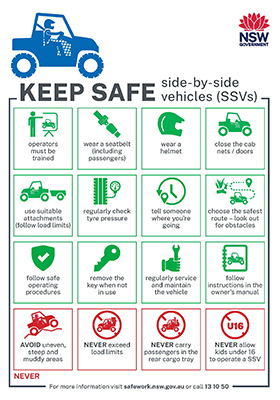
- Avoid uneven, steep and muddy areas.
- If you can’t see what the ground conditions are like, safely park and turn off the vehicle to check the ground on foot before travelling riding through.
- Do not attempt to cross flooded creeks, rivers, causeways, fords or other moving bodies of water – even if it is a well-known crossing. Flood water can significantly change the ground underneath.
- Regularly check tyre pressure and ensure loads are secure. Liquids within a spray tank can alter the vehicle’s centre of gravity and impact stability.
- Set up farm rules in the event of high rainfall or flash flooding. Think about:
- No-go zone areas that are impacted by high rainfall i.e. areas that are prone to flooding, wash outs or landslides, slopes or areas that become muddy and slippery, or terrain that becomes soft or loose
- No-ride rules in heavy rainfall and storms.
- If you have a conditional registration to travel on public roads check for road flooding and closures at Live Traffic NSW
- Establish an emergency plan and make sure everyone understands it (including visitors).
No matter what the weather, you should always:
- use active riding skills to influence stability and keep the vehicle balanced (quad bikes and farm motorbikes)
- wear a helmet (quad bikes, farm bikes and SSVs)
- wear a seat belt in all vehicles that have them (SSVs, tractors and Utes/4WDs)
- tell someone where you are going, and when you plan to return – carry a communication device and a Personal Location Beacon (PLB).
If you are not confident that you can get through a particular area or if it is flooded, do not travel through it. Always choose the safest route.
Bogged vehicles and farm equipment
Ground conditions can also be deceptive after wet weather events.
While the ground may look like it has dried out, it may still be extremely soft and muddy underneath – leading to bogged vehicles or farm equipment.
Never attempt to recover a bogged vehicle unless you have accessed the situation and it is safe to do so.
Keep everyone involved in vehicle recovery safe:
- make sure everyone helping is competent to undertake the recovery job
- only use recovery equipment that is rated for the recovery weight and the type of work involved
- always use a recovery damper to reduce the force of the recoil and risk of injury if the recovery line breaks
- only use anchor points on vehicles and machinery approved by the manufacturer or a competent person
- create an exclusion zone around the vehicle or piece of equipment during the recovery activity
- only the vehicle operator and those necessary in the recovery should be allowed inside the exclusion zone
- ensure anyone within the exclusion zone is standing at 90 degrees to the axis of the tow line
- NEVER stand at either end of the tow line as you are at higher risk of injury if the tow line breaks
- communication is key – agree on an effective communication plan before starting the recovery job e.g. using voice, radio, hand signals etc
- abort the extraction of the bogged vehicle equipment if things are not going to plan.
Support is available
$1000 rebate for roll bars and helmets
Rebates for compliant helmets and roll bars are available for eligible businesses who use quad bikes and SSVs to a maximum of $1,000.
Chat with your local Inspector
Farmers are encouraged to connect with their local SafeWork NSW Inspector for free advice on how to improve safety on their farm.
Request a Workplace Advisory Visit and SafeWork NSW will come to you (phone call or in person). Book online or call 13 10 50.
Check out our free safety shed posters
Display the Keep Safe on Quad Bikes poster (PDF, 117.12 KB)
Display the Keep Safe on SSVs poster (PDF, 169.03 KB)
More information
- Important information for workers and employers about what to do before, during and after a natural disaster – SafeWork NSW
- Quad bike safety – SafeWork NSW
- SSV safety – SafeWork NSW