
nsw logo NSW Government
SafeWork
  • About
  • News
  • Contact
  • Safety
    starts here
  • Your
    industry
  • Advice &
    resources
  • Legal
    obligations
  • Notify
    SafeWork
  • Compliance &
    prosecutions
  • Licences &
    registrations
  • Home
  • Compliance and prosecutions
  • Incident information releases
  • Dangerous scaffold incident (5 October 2023)
Share
  • facebook
  • linkedin
  • email
Print PDF

Dangerous scaffold incident (5 October 2023)

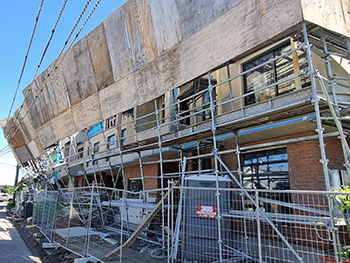
A section of scaffold for a multi-unit residential project has separated from the building face and come to rest against low voltage distribution powerlines. It appears scaffold ties were removed resulting in serious immediate risk of collapse.
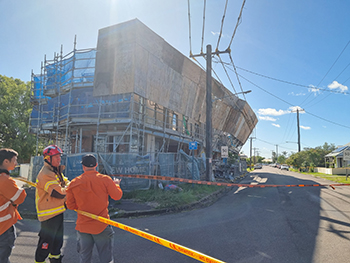
Construction workers at retail site viewing fallen scaffolding
Fallen scaffolding touching power lines

Images of scaffolding on power lines.

Safety information

PCBUs are reminded to consider reasonable and practicable control measures to identify hazards and manage the risk of scaffold collapse:

Ensure:

  • the scaffold is adequately tied to its supporting structure, in accordance with instructions from a competent person. Consult with the scaffold designer, manufacturer, supplier, or an engineer, and prevent unauthorised removal or changes by workers on site
  • to develop systems of work that allow construction activities such as bricklaying, painting, rendering, glazing, and cladding installation to be completed without unplanned changes to or removal of scaffold ties, e.g., relocate ties so they do not interfere with the work. Examples of systems of work, include and are not limited to:
    • providing all workers adequate information, instruction, training and supervision regarding the control measures required to prevent the removal of ties and any other unauthorised alterations that could lead to the collapse of the scaffold
    • workers completing a visual check of the scaffold daily before use and reporting any defects or issues for rectification
    • regular inspection of scaffold ties to check they are not modified or altered by unauthorised people (e.g., finishing trades who may loosen, relocate or remove ties to gain access to walls and openings)
    • all workers completing a site-specific induction and are trained in the appropriate safe work method statement (SWMS)
  • to engage a competent person who holds the same or higher class of high-risk work licence appropriate to the class of scaffolding to regularly inspect the scaffold, at least every 30 days, to ensure it has not been modified or altered by unauthorised persons.
  • a handover certificate must be provided before first use of the scaffold after scaffolders have completed their scaffolding work i.e. after a new scaffold has been erected, or an existing scaffold has been repaired or altered. Examples of alterations requiring an inspection and new handover certificate include:
    • adding/removing additional bays or lifts
    • changing ties or tie locations
    • changing platforms, hop-ups and decking component locations
    • changing edge protection or containment
    • partial disassembly or removing components (e.g., create an access opening)
  • the competent person when erecting and handing over a scaffold for use on site must consider the following:
    • provision and maintenance of sufficient ties of adequate strength for the loads, including wind load
    • ensure the scaffold is stable at all times, including during erection, in situ, during and after any alterations, and when dismantling
    • ensure altering or partially dismantling the scaffold does not weaken it, e.g., removing returns or adjacent bays may require additional ties or bracing on the remaining scaffold
    • scaffolds are not left in a state of weakness when installing or dismantling the scaffolds (e.g., removing returns as they act like ties, or removing ties in preparation for dismantling)
    • ensure the scaffold can withstand all anticipated loads, including the weight of workers, all stored material and any loads due to weather such as wind and rain

On-the-spot fines of up to $3,600 apply for altering a scaffold without a licence or failing to protect workers from the risk of falls from heights.

Statistics

After conducting 428 Scaff Safe 2021 project site visits, SafeWork NSW compiled a report highlighting many unsafe practices in scaffolding. Some key findings include:

  • Principal Contractors had allowed workers to access incomplete scaffolds at 49% of sites
  • 43% of sites had working decks with missing planks, ledgers or hop-ups
  • 43% of sites had missing mid rails
  • 32% of sites did not have a handover certificate (or written confirmation) by a competent person
  • 30% of sites had scaffolds that appeared to have been altered by unlicenced tradies – mostly bricklayers.

Related guidance material

  • Construction Site Supervisor Workshop - Young and at risk workers
  • Young workers eToolkit
  • Checklist for training young workers (PDF, 1191.25 KB)
  • Guide for labour hire workers, apprentices and trainees (PDF, 2988 KB)
  • Managing the risks of plant in the workplace – Code of Practice (PDF, 1987.96 KB)
  • Managing the risk of falls in housing construction – Code of Practice (PDF, 2296.79 KB)
  • Working at heights in construction
  • Roof edge protection fact sheet (PDF, 2885.66 KB)
  • Incident Information – How to prevent falls on a construction site using void covers

Further information

  • Traumatic event management plan – SafeWork NSW
  • Mental health at work – NSW Government
  • Speak Up Save Lives App – SafeWork NSW
  • Subscribe to SafeWork NSW newsletters and updates
Back to top
  • Safety starts here
    • Safety overview
      • First aid in the workplace
      • Emergency plans
      • If you get injured at work poster
      • Mandatory injury register
      • When an incident occurs
      • Health and safety training in the workplace
      • Workers compensation insurance
      • Return to work program
    • Safety support
      • Your rights and responsibilities for health and safety
      • Training & orienting workers
      • Getting workers to contribute to health and safety
      • Managing risk in the workplace
      • Workplace inspections
      • Investigating and reporting incidents
      • Supervisors
    • Building a health & safety culture
      • Building a high performing health &safety culture
      • Active health & safety management
      • Planning for health & safety
      • Leadership and commitment
    • Consultation at work
      • Your duty to consult
      • Consultation case studies and videos
      • Workgroups
      • Safety committees
      • Health and safety representative's toolkit
      • Safety complaints
      • Resolving issues
      • Consultation tools to help
      • Entry permits
      • Discriminatory conduct
    • At risk workers
    • Physical safety at work (the basics)
      • Emergency plans
      • Facilities at work
      • Instruction and training
      • Personal protective equipment (PPE)
      • Pregnancy
      • Sedentary work
      • Violence
      • Bushfire smoke
    • Mental health & safety (the basics)
      • Alcohol and other drugs
      • Mental health @ work
      • Workplace stress
    • SeasonalSAFE
  • Your industry
    • Accommodation and food services
      • Hospitality
    • Administrative and support services
    • Agriculture, forestry and fishing
      • Plant nurseries
      • Farming
    • Arts and recreation services
    • Building and construction
      • Construction work
      • Demolition
      • House construction
    • Education and training
    • Financial and insurance services
    • Health care and social assistance
      • Aged care
      • Hospitals
      • Early childhood education and care
      • Disability support
    • Information media and telecommunications
    • Manufacturing
      • Leading safer manufacturing workplaces
      • Safe work leader talks: safety in manufacturing
    • Personal care and other services
    • Public administration and safety
    • Rental, hiring and real estate services
    • Retail trade
      • Shop with respect poster - A4 size
      • Shop with respect poster - A3 size
    • Transport, postal and warehousing
      • Food delivery industry
    • Wholesale trade
    • Waste management and recycling
  • Advice & resources
    • Campaigns
      • It’s the safe way or 'no way'
      • Getting home safe is what matters most
      • Industrial gate safety
      • International Day of Mourning
      • National Asbestos Awareness Week
      • NSW Dust Strategy
      • WHS Excellence Showcase
      • Falls in transport
    • Free advisory visits and workshops
    • Labour hire
    • Video library
    • Incident animations
    • Online safety webinars
    • SafeWork newsletters
    • Speak Up Save Lives app
    • Translated resources
      • Arabic health and safety resources
      • Assyrian health and safety resources
      • Chinese health and safety resources
      • Dari health and safety resources
      • Fiji health and safety resources
      • Filipino health and safety resources
      • French health and safety resources
      • German health and safety resources
      • Hindi health and safety resources
      • Kiribati health and safety resources
      • Khmer health and safety resources
      • Korean health and safety resources
      • Malay health and safety resources
      • Nepali health and safety resources
      • Punjabi health and safety resources
      • Samoa health and safety resources
      • Spanish health and safety resources
      • Tonga health and safety resources
      • Thai health and safety resources
      • Vietnamese (Tiếng Việt) health and safety resources
  • Legal obligations
    • Employer and business obligations
      • Directors and officers
      • Due diligence
      • Primary duty of care
      • Duty to consult
      • Register of injuries
      • Injuries at work
      • Return to work programs
      • Managing hazards and risks
    • Worker obligations
    • Medical practitioner's obligation to notify of a disease
    • Diversity
    • Visitor obligations
    • Contractors and labour hire
    • Volunteering
    • Strata title and body corporate
    • Legislation
  • Notify SafeWork
    • Incident notification
    • Adverse health monitoring report notification
    • Asbestos notifications
    • Blasting notifications
    • Demolition notifications
    • Fireworks displays notifications
    • Hazardous chemicals notifications
    • Lead notifications
    • Legacy engineered stone notification
    • Provisional Improvement Notices (PIN)
    • Workplace Exposure Standard (WES) exceedance notification
    • Silica worker register (SWR) notification
      • FAQs
  • Compliance and prosecutions
    • Respect at work
    • Incident information releases
    • Improvement, prohibition and penalty notices
    • Internal review of inspector and regulator decisions
    • SafeWork Inspectors
    • Enforceable undertakings
    • Prosecutions
    • High risk workplaces and repeat offenders program
    • Contact our Legal Services
  • Licences and registrations
    • White cards
    • Licences
      • Evidence of identity
      • Regularly check licences
      • Explosives and fireworks licences
      • High risk work licences
      • Traffic Control Work Training
      • Class A asbestos removal licence
      • Class B asbestos removal licence
      • Asbestos assessor licence
      • Unrestricted demolition licence
      • Restricted demolition licence
      • Proof of identity
    • Plant registrations
      • Plant item registration
      • Plant design registration
    • High risk work licence assessor accreditation
    • Registered training organisations (RTOs)
      • How to become an approved RTO to deliver asbestos training
      • General construction induction RTOs
      • High risk work RTOs
      • HSR training providers
      • Traffic controller training
  • Resources
    • Hazards A-Z
    • Resource library
    • Risk radar
    • Speak Up Save Lives
  • SafeWork NSW careers
    • Become a SafeWork NSW Inspector
Community
  • Events
  • Accessibility
  • Order a publication
  • Subscribe – SafeWork newsletters
Legal
  • Privacy
  • Right to Information
  • Terms
  • Disclaimer
  • Copyright
Related sites
  • SIRA (workers compensation)
  • TestSafe
  • icare

Contact

Contact us 13 10 50

Follow us

  • facebook
  • youtbue
  • linkedin
Send us your feedback

Follow us

  • facebook
  • youtbue
  • linkedin
  • Sitemap
  • nsw.gov.au
  • Ministerial media releases
NSW SafeWorks logo NSW SafeWorks NSW SafeWorks logo NSW SafeWorks