
nsw logo NSW Government
SafeWork
  • About
  • News
  • Contact
  • Safety
    starts here
  • Your
    industry
  • Advice &
    resources
  • Legal
    obligations
  • Notify
    SafeWork
  • Compliance &
    prosecutions
  • Licences &
    registrations
  • Home
  • Your industry
  • Agriculture, forestry and fishing
  • Farming
  • Safe recovery of bogged vehicles and equipment
Share
  • facebook
  • linkedin
  • email
Print PDF

Safe recovery of bogged vehicles and equipment

Learn how to prevent bogged vehicles, equipment or machinery on farms, and what to do if recovery is required.

Following wet weather, the risk of vehicles or farm equipment becoming bogged increases.

When attempting to recover a bogged vehicle or farm equipment there is the risk of serious injury or death.

Risks primarily involve the failure of recovery equipment and subsequent propulsion of straps, shackles, or winch ropes/cables.

You can manage these risks better by following these tips.

Tips for avoiding vehicles and farm equipment becoming bogged
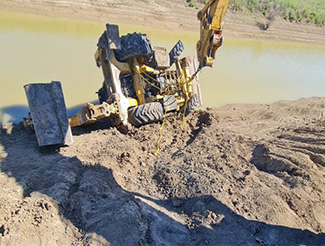
A backhoe that has rolled down the embankment of a flooded creek
  1. Assess the working environment and be aware of the ground conditions. Check if the ground has completely dried out following heavy rain.
  2. Talk to your farm workers and work out a plan in case you need to recover a vehicle or farm equipment.
  3. Rethink using a vehicle or farm equipment in a location where there is a likelihood of getting bogged.
  4. Postpone work until conditions improve.
  5. Consider deflating tyres to a suitable lower pressure for the vehicle to improve traction footprint.
  6. For any water crossings or mud holes, check the depth and condition of the bottom. Also consider the current of a water crossing.
  7. Consider having suitable rated recovery equipment at hand if there is a possibility of being bogged.
  8. If your vehicle stops moving, do not continue to accelerate and spin the wheels. You are likely to dig the vehicle deeper. Re-assess the situation and consider a different recovery strategy.

Reduce the risk to yourself and others

If your vehicle or farm equipment becomes bogged, the following information provides advice to reduce the risk for yourself and others involved in the recovery.

  • Conduct a risk assessment and carry out recovery using your recovery plan. Always inspect recovery equipment to ensure it is not damaged and is fit for purpose.
  • Create an exclusion zone around the vehicle or farm equipment during any recovery activity. Keep people separated a safe distance in case recovery straps or other equipment fail and recoil. Only those people involved in the recovery should be in the exclusion zone.
  • Ensure anyone involved in the recovery is standing at 90 degrees to the tow line. Standing at either end of the tow line increases the risk of serious injury if the tow line breaks.
  • Ensure that effective communication is maintained at all times during the recovery by use of voice, radio, vehicle horn or hand signals.
  • Only use recovery points on the vehicle approved and rated by the manufacturer of the vehicle and/or fitted accessory.
  • Use ropes, straps and attachments that are correctly rated for the weight and type of recovery. Keeping in mind that a vehicle being recovered from mud can increase the weight rating of the vehicle two to three times the normal weight. Consider this when selecting appropriate rated equipment.
  • Use one or more weighted recovery dampeners to reduce the force of recoil should the recovery line break. Dampeners should be placed in the middle or at either end of the strap closer to the middle from the break point.
  • The use of any winch should not exceed the safe working load pulling tension rating and use winch rope blocks to reduce the pulling strain in the winch motor. Always read the recommendations of the winch manufacturer prior to use.
  • Abort the recovery if the vehicle is unable to be recovered safely.
  • Remember that a strap used in a snatch recovery could maintain tension following a recovery attempt. Do not attempt multiple snatch recoveries one after another as this can create a larger amount of tension and cause equipment failure.
  • Note that some recovery equipment such as straps are only meant to be used a set number of times. Use as directed by the manufacturer to reduce the possibility of failure.
  • Ensure that you have an emergency procedure in place in the event of an injury during the recovery.
  • If unsure of a recovery process for a vehicle or piece of farm equipment, engage an external competent person/business to assess and provide the correct equipment to undertake the recovery safely.

Related guidance material

  • Managing the risks of plant in the workplace - Code of Practice (PDF, 1987.96 KB)
  • Safe recovery card poster (PDF, 53.89 KB)
  • Safety around your vehicle (SAYV) glove box guide
  • WHS duties in the agricultural industry - Safe Work Australia

Further information

  • Incident information release: Bogged farm machinery fatality – high rainfall and flash flooding warning can impact ground conditions
  • Traumatic event management plan
  • Quad bike and SSV safety rebate
  • Speak Up Saves Lives app
Back to top
  • Safety starts here
    • Safety overview
      • First aid in the workplace
      • Emergency plans
      • If you get injured at work poster
      • Mandatory injury register
      • When an incident occurs
      • Health and safety training in the workplace
      • Workers compensation insurance
      • Return to work program
    • Safety support
      • Your rights and responsibilities for health and safety
      • Training & orienting workers
      • Getting workers to contribute to health and safety
      • Managing risk in the workplace
      • Workplace inspections
      • Investigating and reporting incidents
      • Supervisors
    • Building a health & safety culture
      • Building a high performing health &safety culture
      • Active health & safety management
      • Planning for health & safety
      • Leadership and commitment
    • Consultation at work
      • Your duty to consult
      • Consultation case studies and videos
      • Work groups
      • Safety committees
      • Health and safety representative's toolkit
      • Safety complaints
      • Resolving issues
      • Consultation tools to help
      • Entry permits
      • Discriminatory conduct
    • At risk workers
    • Physical safety at work (the basics)
      • Emergency plans
      • Facilities at work
      • Instruction and training
      • Personal protective equipment (PPE)
      • Pregnancy
      • Sedentary work
      • Bushfire smoke
    • SeasonalSAFE
  • Your industry
    • Accommodation and food services
      • Hospitality
    • Administrative and support services
    • Agriculture, forestry and fishing
      • Plant nurseries
      • Farming
    • Arts and recreation services
    • Building and construction
      • Construction work
      • Demolition
      • House construction
      • Codes of practice
    • Education and training
    • Financial and insurance services
    • Health care and social assistance
      • Aged care
      • Hospitals
      • Early childhood education and care
      • Disability support
    • Information media and telecommunications
    • Manufacturing
      • Leading safer manufacturing workplaces
      • Safe work leader talks: safety in manufacturing
    • Personal care and other services
    • Public administration and safety
    • Rental, hiring and real estate services
    • Retail trade
      • Shop with respect poster - A4 size
      • Shop with respect poster - A3 size
    • Transport, postal and warehousing
      • Food delivery industry
    • Wholesale trade
    • Waste management and recycling
  • Advice & resources
    • Campaigns
      • It’s the safe way or 'no way'
      • Getting home safe is what matters most
      • Industrial gate safety
      • International Day of Mourning
      • National Asbestos Awareness Week
      • WHS Excellence Showcase
      • Falls in transport
      • Safe Work Month
    • Free advisory visits and workshops
    • Labour hire
    • Video library
    • Incident animations
    • Online safety webinars
    • SafeWork newsletters
    • Speak Up Save Lives app
    • Translated resources
      • Arabic health and safety resources
      • Assyrian health and safety resources
      • Chinese health and safety resources
      • Dari health and safety resources
      • Fiji health and safety resources
      • Filipino health and safety resources
      • French health and safety resources
      • German health and safety resources
      • Hindi health and safety resources
      • Kiribati health and safety resources
      • Khmer health and safety resources
      • Korean health and safety resources
      • Malay health and safety resources
      • Nepali health and safety resources
      • Punjabi health and safety resources
      • Samoa health and safety resources
      • Spanish health and safety resources
      • Tonga health and safety resources
      • Thai health and safety resources
      • Vietnamese (Tiếng Việt) health and safety resources
    • Health and Safety Representatives
  • Legal obligations
    • Employer and business obligations
      • Directors and officers
      • Due diligence
      • Primary duty of care
      • Reasonably practicable
      • Duty to consult
      • Register of injuries
      • Injuries at work
      • Return to work programs
      • Managing hazards and risks
    • Worker obligations
    • Medical practitioner's obligation to notify of a disease
    • Diversity
    • Visitor obligations
    • Contractors and labour hire
    • Volunteering
    • Strata title and body corporate
    • Legislation
  • Notify SafeWork
    • Incident notification
    • Adverse health monitoring report notification
    • Asbestos notifications
    • Blasting notifications
    • Demolition notifications
    • Fireworks displays notifications
    • Hazardous chemicals notifications
    • Lead notifications
    • Legacy engineered stone notification
    • Provisional Improvement Notices (PIN)
    • Workplace Exposure Standard (WES) exceedance notification
    • Silica worker register (SWR) notification
      • FAQs
  • Compliance and prosecutions
    • Respect at work
    • Incident information releases
    • Improvement, prohibition and penalty notices
    • Internal review of inspector and regulator decisions
    • SafeWork Inspectors
    • Enforceable undertakings
      • Years
    • Prosecutions
    • High risk workplaces and repeat offenders program
    • Contact our Legal Services
  • Licences and registrations
    • White cards
    • Licences
      • Evidence of identity
      • Regularly check licences
      • Explosives and fireworks licences
      • High risk work licences
      • Traffic control work training
      • Class A asbestos removal licence
      • Class B asbestos removal licence
      • Asbestos assessor licence
      • Unrestricted demolition licence
      • Restricted demolition licence
      • Proof of identity
    • Plant registrations
      • Plant item registration
      • Plant design registration
    • High risk work licence assessor accreditation
    • Registered training organisations (RTOs)
      • How to become an approved RTO to deliver asbestos training
      • General construction induction RTOs
      • High risk work RTOs
      • HSR training providers
      • Traffic controller training
  • Resources
    • Hazards A-Z
    • Resource library
    • Risk radar
    • Speak Up Save Lives
  • SafeWork NSW careers
    • Become a SafeWork NSW inspector
Community
  • Events
  • Accessibility
  • Order a publication
  • Subscribe – SafeWork newsletters
Legal
  • Privacy
  • Right to Information
  • Terms
  • Disclaimer
  • Copyright
Related sites
  • SIRA (workers compensation)
  • TestSafe
  • icare

Contact

Contact us 13 10 50

Follow us

  • facebook
  • youtube
  • linkedin
  • instagram
Send us your feedback

Follow us

  • facebook
  • youtube
  • linkedin
  • instagram
  • Sitemap
  • nsw.gov.au
  • Ministerial media releases
NSW SafeWorks logo NSW SafeWorks NSW SafeWorks logo NSW SafeWorks