
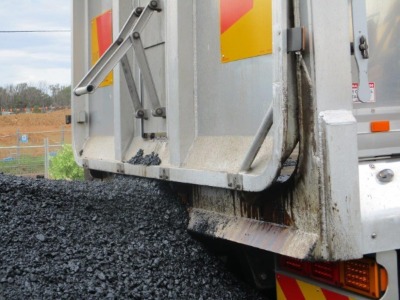
This safety alert reminds people working with tipper trucks (tippers) of the hazards related to being close to the rear tailgate while tipping. The associated risks include being struck by an unsupported tailgate or being engulfed by the sudden release of material.
Background
In November 2018, a worker sustained serious injuries while operating the grain chute in the tailgate of a raised tipper body (or bin). Early investigations suggest at the time of the incident the tipper body was inclined and the tailgate was closed. The inclination of the tipper body caused the material within it to place excessive forces on the tailgate. As a result, the tailgate failed and the material within the tipper body suddenly released, engulfing the operator. Investigations into the incident are ongoing.
Key considerations
Tailgates on tipper bodies may not be designed to bear loads during tipping. This means if the tailgate is closed while the tipper body is inclined, there is a risk the tailgate will suddenly and unexpectedly open.
The movement of materials within a tipper body, either under transportation or operation of the tipper, may place excessive forces on the tailgate.
The weight of tailgates may expose workers to possible crushing or shearing hazard.
Actions required
For people working with tippers:
Check the operation manual and talk with the manufacturer to know the operating conditions of your tipper / tipper body.
Never work under a raised load. Do not approach, or work close to, the rear tailgate while the tipper body is inclined. This includes when undertaking cleaning and maintenance work.
Grain chutes should only be used for materials that are free-flowing when the tipper body is horizontal (flat), and that do not expose workers to hazards like heat or dust.
Only use grain chutes when the tipper body is in the horizontal position and the truck is parked on a firm, level surface.
For designers and manufacturers of tippers:
Designers and manufacturers of tipper and tipper bodies have specific duties under Work Health and Safety law. You must, so far as is reasonably practicable:
- ensure the tipper and/or tipper body is designed and manufactured to be safe for any person who carries out a foreseeable activity with it (within the purpose for which it is designed), or any person who is near it while such activities are being carried out. Such activities include the manufacture, assembly, operation, maintenance or cleaning of the truck;
- carry out the necessary calculations, analysis, testing or examination to make sure the tipper and/or tipper body is safe, or arrange for them to be carried out. This includes, for example, making sure the tipper body complies with the loading performance standards set out in the Heavy Vehicle (Mass, Dimension and Loading) National Regulation;
- provide information regarding the purpose of the design, the results of any calculations and testing etc., and any conditions needed to make sure the tipper and/or tipper body is manufactured, assembled, operated, maintained and cleaned etc. safely. This may include, for example, an operation manual that sets out the hazards that have not been managed within the design and which are unique to the design.
When making sure the design is safe, designers must identify all foreseeable hazards and eliminate those hazards in the design. If it is not reasonably practicable to eliminate the hazards, the associated risks must be managed in accordance with the hierarchy of controls. Examples of control measures include:
- excluding grain chutes from the design when the tipper bin will be used exclusively for materials that do not flow easily
- making sure grain chutes must be operated from the side of the tipper bin, eliminating the need for the operator to work behind the tailgate
- include in the design of the tailgate:
- integrated operating functions, preventing the tipper body being raised unless the tailgate is unlocked
- over centre locking mechanisms, screw locks, additional brake boosters, grain locks etc.
- physical and/or electrical indicators, from which the operator can clearly identify whether the tailgate is in the locked or unlocked position, without needing to be near the tailgate.
Further information
- Work Health and Safety Act 2011 and Work Health and Safety Regulation 2011
- SafeWork NSW Code of Practice: Managing the risk of plant in the workplace
- National Transport Commission - Load Restraint Guide 2018
- National Heavy Vehicle Regulator - Law and Regulations
- Australian Standard AS:4024.1 - 2014 Safety of Machinery.