

Download this guide (PDF, 990.16 KB)
© State of New South Wales (SafeWork NSW). Information contained in this publication is based on knowledge and understanding at the time of writing, February 2024, and is subject to change. For more information, please visit SafeWork's copyright page.
This publication may contain information about the regulation and enforcement of work health and safety in NSW. It may include some of your obligations under some of the legislation that SafeWork NSW administers. To ensure you comply with your legal obligations you must refer to the appropriate legislation. Information on the latest laws can be checked by visiting the NSW legislation website NSW legislation website. This publication does not represent a comprehensive statement of the law as it applies to particular problems or to individuals or as a substitute for legal advice. You should seek independent legal advice if you need assistance on the application of the law to your situation.
A guide to offer practical support for duty holders, including Persons Conducting a Business or Undertaking (PCBU) and Officers, to use work design to manage the risk of psychosocial hazards.
This guide (the Guide) offers practical support for duty holders, including Persons Conducting a Business or Undertaking (PCBU) and Officers, to use work design to manage the risk of psychosocial hazards. The information in this guide has been prepared to support duty holders comply with their obligations under the Work Health and Safety Act 2011 (NSW) (WHS Act), the Work Health and Safety Regulation 2025 (NSW) (WHS Regulation), and align to the NSW Code of Practice: Managing Psychosocial Hazards at Work 2021 (the Code of Practice).
A PCBU must implement control measures to eliminate psychosocial risks so far as is reasonably practicable. If that is not reasonably practicable, they must minimise psychosocial risks that may harm workers’ psychological or physical health and safety, so far as is reasonably practicable.
Duty holders can most effectively and efficiently eliminate or minimise psychosocial hazards and risks by improving the design of the work, workplace, and systems of work, so workers are not exposed to a psychosocial hazard as described in section 55A(a) of the WHS Regulation.
The WHS Regulation requires duty holders to have regard to a range of matters when determining control measures to implement, including:
Many psychosocial and physical hazards and risks emerge from the same underlying causes or work systems issues.
This guide advocates using ‘systems thinking’ (as described in the ‘Key Terms’) to consider how the different parts of a work system combine and interact to create health and safety risks, and to support or erode the effectiveness of workplace controls. By applying systems thinking, duty holders can better identify and understand these interconnections to then design systems of work that align with the WHS Regulation. It can also help them identify which work design control options are the most important or critical to workers’ health and safety. The duty holder can start with these and then address remaining risks.
Work design as a control measure can therefore address the underlying root causes contributing to psychosocial hazards. This makes it a more efficient and effective risk management approach that is less reliant on human behaviour than other controls.
Users of this guide should first read the duties, requirements, and processes set out in the Code of Practice.
This guide provides information on how to design work and systems to eliminate and minimise psychosocial hazards and risks as set out in the WHS Regulation and the Code of Practice.
This guide primarily provides information for a PCBU, Officers (such as Board members and Executives Directors), senior managers and WHS Professionals who may be providing advice on psychosocial risk management to the PCBU and Officers.
The guide should also be read by managers from areas providing performance information to executives and senior leaders. It should also be used by areas within organisations involved in strategy and resourcing decisions that impact or may impact psychosocial risks and the use of control measures. These areas may include project management, information technology, engineering, procurement, WHS and human resources.
The guide will also be of interest to workers and their health and safety representatives (HSRs).
The Psychosocial Hazard Work Re-Design Tool (PHReD-T) (PDF, 2383.37 KB) was designed as an aid for developing skills, competency, and confidence in work redesign. The work redesign strategies are developed to prevent and manage psychosocial risks. It was originally developed for people with responsibilities for managing WHS, such as WHS advisors, consultants and managers, but is also relevant to a range of roles, including HR and any other managers with WHS duties. The PHReD-T is accompanied by a range of supporting materials that provide information about mental health, psychosocial risks, and work design. These include audio case studies, activities to complete, a fully worked example of the PHReD-T, and reading materials. The PHReD-T resources are practical tools to assist with applying the information in this guide.
For the purposes of this guide:
A guide to offer practical support for duty holders, including Persons Conducting a Business or Undertaking (PCBU) and Officers, to use work design to manage the risk of psychosocial hazards.
From a WHS perspective, work design is a methodical process which helps you understand your work context and then implement improvements to eliminate or minimise WHS risks to your workers.
Your work context is the environment and circumstances in which your organisation is operating and/or work tasks are occurring. It includes:
Once you have a clearer understanding of your work context you are better placed to implement improvements to the design of the work and systems of work. These make sure any identified psychosocial and physical (biomechanical, chemical, and biological) hazards are eliminated or minimised so that they do not create a risk to workers’ health and safety.
Work design goals and processes may differ depending on an organisation’s motivations and objectives. Many different disciplines use work design to achieve their goals, such as WHS, public health, engineering, human resource, or industrial relations management professionals.
This guide’s focus is from a WHS perspective.
People are central to every organisation achieving its objectives. Work design can help organisations achieve their objectives safely and more efficiently. Effective work design processes use systems thinking to help duty holders understand what factors are supporting or eroding workplace controls, and – by extension – the health, safety and performance of individuals and teams.
Workers should receive the highest level of protection against harm to their health, safety and welfare from hazards and risks arising from work, so far as is reasonably practicable. Duty holders must have regard to a range of matters including how hazards and risks may interact and combine, and the sources of risk such as the poor design of work and systems of work.
Applying effective work design approaches means PCBUs are far more likely to comply with their WHS duties by eliminating or minimising hazards and risks at the source. They are also more likely to address psychosocial risks that may contribute to dangerous that may harm their people, equipment, operations, and organisational reputation.
Designing out psychosocial hazards and risks and ‘designing in’ positive features to boost workers’ resources can reduce stress, burnout, fatigue, work-related injury, illness and even death. It can reduce errors (and their costs), improve job satisfaction (and worker engagement and retention), and the organisation’s resilience to adapt and respond to changing operational pressures and incidents.
Psychosocial hazards at work are aspects of work and situations that may cause a stress response which in turn can lead to psychological or physical harm. They can stem from:
Psychosocial hazards are slightly different in every workplace and even between teams. They depend on the type of work being done, controls already in place, and workers’ skills and attributes.
Some of the most common psychosocial hazards are noted in the following section. Some of these hazards may be hazardous by themselves, others may only be so if combined with other hazards.
Duty holders must consider the nature of psychosocial hazards exposure in their organisations including:
These obligations are provided for in clause 55D(2) of the WHS Regulation.
There are two broad types of exposure to psychosocial hazards and risks - both lead to harm:
In practice, workers can be exposed to both types of psychosocial hazards and risks. The more psychosocial and physical hazards present at any one time, the more likely it is for harm to occur.
There may be psychosocial hazards and situations used in this guide that are not relevant to your work, or relevant to your work but not included in this guide. You can identify these hazards through systematic hazard and risk identification processes as required under clause 34 of the WHS Regulation. The list below includes some of the most common psychosocial hazard types and examples:
High work demands:
Low work demands:
Exposure to traumatic events:
Role conflict or lack of role clarity:
Low job control:
Poor support:
Poor working environments:
Remote or isolated work:
Inadequate reward and recognition:
Poor procedural justice:
Poor organisational change consultation and management:
Conflict or poor working relationships:
Harassment including sexual harassment:
Bullying:
Workplace aggression and violence:
Many organisations consider psychosocial and physical hazards separately. In reality, psychosocial and physical hazards combine or interact to create risk, such as the combination of low job control and high demands. Organisations often fail to identify the underlying causes of risk and many settle for inadequate and lower-order control measures. These are not only less effective but also waste precious time and resources. These organisations are not complying with their WHS duties effectively.
Exposure to psychosocial hazards can lead to stress – the psychological and physical responses that occur when a worker perceives that the work demands exceed their ability or resources to cope.
Work-related stress may not itself constitute a physical or psychological injury. However, if stress is prolonged and/ or severe, it can contribute to:
Organisations often become aware of poor work design and management practices as they investigate complaints about unacceptable or harmful workplace behaviours. Harmful workplace behaviours (bullying, aggression, or any form of harassment) can be by-products of underlying poor work design, systems of work and organisational culture, as well as individuals’ own beliefs and attitudes.
Addressing poorly designed work, such as roles with excessive workloads, role ambiguity, or unclear systems of work, can help minimise contributing factors. These are under a PCBU’s control so good work design can ensure that harmful workplace behaviours will be far less likely to arise or, if they do, that they will be manageable.
A guide to offer practical support for duty holders, including Persons Conducting a Business or Undertaking (PCBU) and Officers, to use work design to manage the risk of psychosocial hazards.
The WHS legislation and WHS Regulation sets out what PCBUs must do to comply with WHS laws.
The WHS Act requires a PCBU to ensure, so far as is reasonably practicable, the health and safety of workers and others.
The WHS Regulation (clause 55D) states PCBUs must implement control measures—
The WHS Regulation (clause 55D(2)) reinforces that the duty holder must have regard for all relevant matters when managing psychosocial risks and selecting control measures. This includes:
Under section 16 of the WHS Act, more than one person can have a duty around the same matter that may be leading to a psychosocial risk. All PCBUs who share a WHS duty, must as far as is reasonably practicable, consult, cooperate, and coordinate activities with each other to manage the psychosocial risks (sections 15-19 and 46 of the WHS Act).
A guide to offer practical support for duty holders, including Persons Conducting a Business or Undertaking (PCBU) and Officers, to use work design to manage the risk of psychosocial hazards.
PCBUs are responsible for making sure psychosocial risks are systematically and appropriately managed.
The Code of Practice describes a recommended systematic process PCBUs can use to manage these risks, as shown in Figure 1: Psychosocial risk management cycle.
The steps of the psychosocial risk management cycle are:
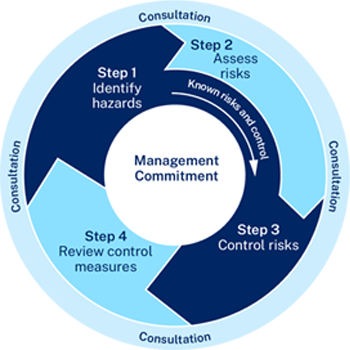
The Code of Practice also clearly outlines some essential elements of an effective risk management process including:
Systems thinking is an approach used in work design to help identify and better understand the dynamic relationships between key parts of the work system. It considers how these parts and relationships may create psychosocial hazards and risks, and support or erode the effectiveness of workplace controls. These insights can then be used to design out the underlying causes and to design in solutions.
This big picture approach considers the whole work system and how the five elements that make up the work system overlap, as illustrated in Figure 2: Work Systems. The five elements include:
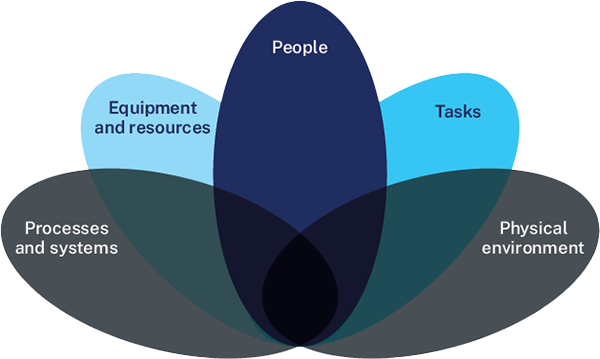
PCBUs might also want to consider external factors that can impact the work system, such as the prevailing economic conditions, operating regulations and even community norms.
Using systems thinking can also offer clues on why something that was considered an ‘effective control measure’ and ‘safe way of working’ may gradually drift towards becoming unsafe.
To effectively identify psychosocial hazards and their causes, leaders should clearly understand who in the organisation is making decisions that directly or indirectly impacts how work is done, and how it may create psychosocial risks.
It is important to have frank and open discussions with affected workers and their representatives from across your organisation to better understand how ‘work is really done’ in normal operating conditions, peak periods and during emergencies. You can then compare this to how work is ‘imagined’ and ‘prescribed’ (such as in position descriptions, operating and safety documents, and training materials). Doing this comparison should help organisations uncover the things that are going right and why, so you can support these to keep happening. Effective worker consultations can help you make sure future work and systems of work design are better at managing psychosocial risks in both normal and emergency situations.
In practice, work design is done by many different people within an organisation. Some of these people may not be very aware of how their decisions impact on work design, or the WHS duties and obligations of their employer or themselves. Some examples of how decisions made in different roles can impact psychosocial risk and influence work design include:
Some work design decisions will also be influenced by external parties such as clients and suppliers, where clients have unrealistic expectations or suppliers are unable to meet deadlines.
To make sure work is appropriately designed and managed, duty holders should make sure:
SafeWork NSW’s Code of Practice: Work health and safety consultation (PDF, 635.62 KB), cooperation and coordination includes useful information to help you make sure that work design issues are adequately considered by organisations that may have shared duties.
Psychosocial hazards and risks typically arise from underlying work design issues at many different levels within an organisational system, including design at task level, job level, team level, and organisational wide.
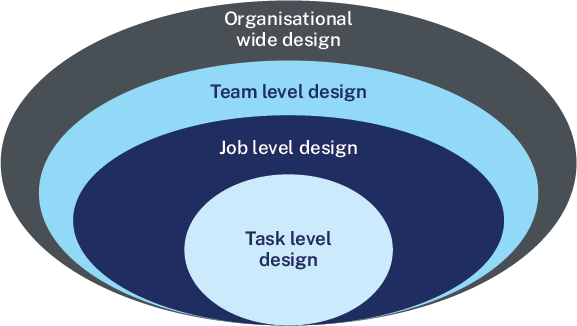
Organisational wide design issues impacting all staff, such as organisational and management restructures.
Team-level design issues, such as how work is organised and allocated.
Job and task design issues, such as excessive workloads, role ambiguity, or conflicting work priorities.
Duty holders, in managing risks to health and safety, must identify reasonably foreseeable hazards, including psychosocial hazards, that could give rise to risks to health and safety. This may include psychosocial hazards arising from poor work design which may create a psychosocial risk in the organisation. You should also consider how work design at each level combines and interacts to create psychosocial hazards and risks for workers. You must make changes to work design to manage these risks.
Work design can be done at different times. The effort required will vary depending on the goal.
Times when a duty holder should review existing work design and consider improvements include when:
Most organisations may already use a range of approaches to help them identify psychosocial hazards, assess risk, and monitor risk control measures. This may include, collecting:
For more information see SafeWork NSW’s Code of Practice: Managing Psychosocial Hazards at Work and SafeWork NSW’s Guide: Measuring and Reporting WHS Information (PDF, 854.37 KB).
There are many different work design models. If you are interested in learning about some of the academic basis for these, visit the OHS Body of Knowledge.
The following section includes some suggested approaches to risk identification that organisations can use in addition to any approaches they already have in place. Most organisations should be able to apply these without the help of a specialist. In some cases, organisations might want to use an expert or a specialist to be evidence-based and minimise bias. Using external specialists may help workers feel safer to disclose sensitive information.
Duty holders should look beyond surface-level causes of a situation and seek a deeper understanding of them. Some issues are readily observable; however, it is what lies beneath that may be even more important.
It may help to ask subject matter experts and affected workers questions to better understand:
Repeatedly asking why a situation or psychosocial risk might arise is one of the simplest and most useful methods to better identify and understand why hazards or risks exist in the workplace.
To begin the process, first collect some basic information about the psychosocial hazard or risk:
Once you have collected this information, ask ‘Why?’ this might have happened. This process should help give a clearer picture of the underlying issues and contributing causes. Asking a ‘why?’ question five times comes from the observation that this number is usually sufficient to reveal the main causes and factors behind an issue. To get the best results, make sure the person leading this process is competent and impartial.
Appendix 1 has some additional information to help with a ‘Five Why’ discovery process.
A task hazard analysis describes the overall task goals (what needs to be achieved). Then it systematically uses a top-down approach to break down the key steps of the task and describe the required actions and the relationships between each.
The technique can be used to gain insights into psychosocial hazards and risks, safety critical decisions, and dependencies (like other workers’ actions, or essential information and equipment needed if work is to be completed safely and on time and to budget).
It can also help uncover common ‘workarounds’ (both beneficial and dangerous) and noncompliance with work procedures.
Jobs can include many tasks and elements. From a WHS perspective it is helpful and more efficient to focus on those associated with the highest risk of harm, rather than do a task hazard analysis for every task that makes up a whole job.
The first step, therefore, is to look at the inherent requirements of the job. Based on that information then choose the most hazardous tasks within that job and undertake a task hazard analysis for each.
The task hazard analysis should describe the:
Whether or not you need to keep breaking tasks down into finer detail depends on whether this will reveal further useful information about psychosocial hazards and risks.
A task hazard analysis is best represented and understood as a flow diagram. Appendix 2 has some additional information about this process.
All work requires cognitive and emotional effort. Many organisations may not currently pay enough attention to these important demands.
It is an important part of the task analysis to consider the cognitive task demands, such as the need for attention, perception, memory, active listening, and decision-making.
Emotional demands might include:
A cognitive and emotional task analysis builds on, or could be incorporated into, the job or task hazard analysis described above. It should provide additional information to help unpack the thought processes and decision making that underlie workers’ observable actions, including both useful ‘workarounds’ and those that may lead to errors.
This analysis is particularly important when tasks are being automated and workers may need to quickly diagnose and respond to situations that were not anticipated by engineers or designers. It’s also important in novel situations when workers might be under time pressure and/or experiencing stress.
Once organisations understand what, when and why problems might arise due to excessive cognitive and emotional demands, you can design appropriate decision support systems, including training and supervision. This includes allowing workers (where they have appropriate skills and experience) reasonable control to flexibly respond to these problems as they arise.
While duty holders may need the help of an ergonomist or organisational psychologist to do a comprehensive analysis of this type, they can start by discussing with workers the things that may influence their thought and emotional processes and responses.
Start by asking workers questions which help you understand:
Prestart checks (when done well) are an example of a rapid and often informal task analysis process. These are often used shortly before a task starts where residual risks remain that may rapidly change over the shift. Prestart checks can be included in safety huddles, handovers, and meetings, and so on.
Prestart checks can be part of a safe system of work if done well with adequate time and genuine worker participation, and not just as a ‘compliance tick and flick’ exercise. They can be especially useful when the process is done at ‘the point of risk’ just before workers will be experiencing the risks. Then they are more likely to reflect the ‘work as done’ rather than ‘work as imagined or hoped for.’
The prestart check can be useful for:
Take the opportunity to consider how prestart checks are done in your organisation and if they can be better designed.
There are several well recognised serious threats to the accuracy of risk assessments. One of these is that people are prone to bias. It is important that the assessment of the likelihood and consequences of psychosocial risks is based on sound evidence, not opinion. Do not guess or make assumptions. Make sure you collect and use relevant evidence and, if required, involve experts to manage potential biases in your identification, assessment, and work design processes.
The best risk identification and work design approaches will use ‘subject matter experts’. These may include experienced workers, HSRs, Health and Safety Committee members, managers, WHS staff and sometimes even unions or customers familiar with the common psychosocial risks, challenges, and solutions. Involving a diverse group can help to address bias and knowledge gaps.
Larger organisations may also choose to get assistance from design specialists like ergonomists/ human factors, psychologists, or engineers (who can use objective work measurement and visual representation tools).
Many organisations are choosing to use the free People at Work Psychosocial Risk Assessment Survey Tool. This is an online, well-validated and confidential tool that you can use to survey groups of workers (20 or more) about their experience with common psychosocial risks and some biomechanical risks. The risks the tool focuses on align with those in the Code of Practice. The tool automatically generates a results report that can be used and interpreted by experienced WHS or HR professionals.
Leaders can choose to ask staff from across their whole organisation to complete the survey. This will help you identify common psychosocial hazards and which teams are most at risk, so you can then prioritise work design for these groups. Alternatively, if you already know the teams or work areas who are more likely to be at risk of psychosocial hazards, you can survey those groups only.
The People at Work website includes numerous resources to assist Australian duty holders to design work and manage risks. While these best suit medium to large-sized organisations, the site also includes some useful tips and information for smaller organisations.
Other proprietary validated psychosocial surveys and tools are available. Most require the assistance of an experienced human factors specialist or organisational psychologist to use and interpret them.
If the task analysis, surveys, or other processes have identified that inappropriate workloads are an issue, explore this further.
You may be able to tell your workers have inappropriate workloads through evidence of long working hours; regular reports from workers of feeling rushed (excessive time pressure); conflicting work priorities; poor match of tasks with worker skills; some workers routinely missing their breaks; or reports from workers of fatigue and stress.
You can use the approaches below to learn more about workload issues in your organisation. For the best results, these are best used in conjunction with systems thinking and hazard analysis approaches.
These are a relatively straightforward way to collect information. They can supplement data and insights from surveys indicating that workloads are perceived as a serious problem. You can get further insights on problems or issues from the group, as well as work design suggestions from subject matter experts including affected workers. The People at Work website has information on how to run these focus groups. Remember to carefully choose competent and trusted people to run these sessions.
Some sectors like health, education, aviation, and defence have specialised workload tools and algorithms. These can help document key tasks, timelines, resources, dependencies, priorities, and allocate human and financial resources. However, they are usually based on very strict assumptions and rarely use systems thinking. They may not adequately consider how psychosocial hazards interact to generate perceptions of high workloads. If you use these tools, combine them with other data and information sources.
Time and motion studies, monitoring heart rates, eye movements and other physiological measures are increasingly available tools. However, they are expensive as they require experts to use and analyse them. They are probably unnecessarily complicated for most organisations. If you do use them, make sure you also use other information sources to identify psychosocial risks and the system issues which underly these.
A guide to offer practical support for duty holders, including Persons Conducting a Business or Undertaking (PCBU) and Officers, to use work design to manage the risk of psychosocial hazards.
Psychosocial control measures are the wide range of measures that could be put in place to manage a psychosocial risk at work. PCBUs need to use a combination of control measures.
The goal of your work design process should be to eliminate psychosocial hazards by designing the work tasks, organisation, working environment and equipment so workers are never exposed to that hazard. Only if that is not reasonably practicable, then minimise psychosocial risks through improved design of the work, workplace, plant, structures, and the systems of work.
Following the steps recommended in the Code of Practice (illustrated in Figure 4: Psychosocial risk management cycle), once you have completed steps 1 and 2 to identify and assess the key underlying cause of the psychosocial risks and prioritised these, you can move to step 3 to consider work design options to control the risks. Part of this step will be to test and put in place appropriate design solutions. Step 4 involves reviewing these control measures and solutions.
The WHS Regulation (clause 55D) and related Code of Practice calls out specific matters to consider when choosing and putting in place control measures.
Safe Work Australia’s handbook Principles of good work design lists three WHY, three WHAT and four HOW work design principles that can underpin the design process.
This guide suggests some additional principles on how to design work. These are to:
The PCBU must implement control measures ‘so far as is reasonably practicable’ to make sure that you have eliminated psychosocial hazards. The best way to do this is by designing the hazard out.
If that is not reasonably practicable, then the duty holder must have regard to all relevant matters in clause 55D(2) to minimise psychosocial risks. This should include considering whether it is reasonably practicable to wholly or partly substitute the hazardous way of working with a safer alternative(s). Two important steps to achieve this are to improve the design of work or change the system(s) of work.
While a PCBU is not obliged to use hierarchy of control (HoC) measures under clause 55C of the WHS Regulation, a PCBU may use HoC measures if this helps you choose and communicate the most effective control measures to decision makers and workers in the organisation. Importantly, it is worth noting that this exception (not being obliged to use HoC) only applies with reference to psychosocial risks.
Work design approaches aim to use a combination of control measures which:
Your psychosocial hazard identification and assessment steps should produce a wide range of possible work design solutions for you to consider and apply where appropriate.
In the next section there are some more suggestions on how to address some of the most common poor work design and management issues that impact psychosocial risk. The Code of Practice pages 28-37, and Appendix 3 of this guide, have examples of common scenarios with work design as a psychosocial risk control measure.
Due to the nature of their tasks, some workers (such as truck drivers, or open-cut coal mine operators) have very little job control. Where this is the case, it is even more important that they are adequately consulted, and other work design options are put in place to moderate psychosocial risks.
Many psychosocial risks may impact multiple teams across organisations. For example, risks such as the design and maintenance of IT systems, new or existing technologies or infrastructure, tensions around office relocations or restructures, and hours of work and/or rosters.
Typically, you can address these through early effective communication and genuine consultation with workers about the issues. This can help to reduce uncertainty and make sure proposed changes are appropriately planned and done.
If a SafeWork NSW Inspector visits and the duty holder has identified these issues, we will expect you to be able to show how you have genuinely consulted with workers and taken their views into account.
An organisation was planning to upgrade its ageing IT equipment and software. The original procurement and rollout plan was scheduled to take three months. When it consulted with workers, the organisation realised it had not built in training or piloting of the new software with experienced and novice users into this timetable.
The organisation extended the rollout to include a pilot stage. This led to the organisation finding out it needed to change software to streamline processes and reduce mental workloads. The pilot also showed even experienced workers would need several days training to operate the program and would have an increased mental workload until they got used to the new system. The organisation gave all workers training and reduced its work output expectations while workers became skilled at using the program. The IT team provided practical support and help for several weeks after the rollout.
Planning to deliver services, produce goods, manage fit-outs, move offices, downsize or upsize, recruit staff and design organisational structures are all part of normal business operations.
It can be easy to overlook applying good work design when embarking on these ‘business as usual’ projects. However duty holders should think about work design at all stages of a project. Sometimes it can help to use project management tools to think about work from concept through to closure.
There are opportunities to proactively find and manage key psychosocial risks effectively from the start of the project. Doing this will often help you avoid costly redesign issues or workarounds that may lead to poorer results than you had originally pictured.
There are legal duties and obligations for PCBUs to make sure that psychosocial and physical risks to the health and safety of workers and others are effectively managed throughout the entire life cycle of a project. This includes duties to, as far as is reasonably practicable, consult, cooperate and coordinate with all other persons who have a duty in relation to the same matter (section 46, WHS Act 2011), and to have regard to the design of work, to eliminate or minimise psychosocial risks as is reasonably practicable (clause 55D, WHS Regulation).
Unfortunately, despite the legal requirement to consult with other duty holders and workers so far as is reasonably practicable, many organisations do not routinely include workers and WHS subject matter experts in project planning, especially during the concept and development phases.
Typically, WHS staff and workers are only consulted immediately before or during implementation (execution), when the opportunities to make significant design changes are usually low and the cost of any changes is higher. Organisations therefore miss important opportunities to improve work design.
Organisations must make sure they genuinely consult, coordinate and cooperate with other duty holders, relevant workers and local subject matter experts at the start and throughout the entire project lifecycle.
Project management tools can be very useful. However, remember these are often based on the ‘work as imagined’ rather than ‘work as done.’ To make sure your projects reflect your organisation’s real timelines and dependencies, and capture the real human and financial resources needed, consult your workers. Some project management tools may be complex to use and interpret. To help create a culture of trust, explain them simply to affected workers.
PCBUs must make sure, so far as is reasonably practicable, they provide and maintain safe systems of work. This includes considering the design and management of workload in peaks and troughs. This duty rests with the PCBU and cannot be delegated or contracted out (sections 14 and 272 of the WHS Act).
Line managers are often responsible for the day-to-day decisions around workloads. PCBUs should give these managers reasonable flexibility and autonomy so they can effectively manage staff workloads and make adjustments to deal with day-to-day changes. In turn, managers should give information to the PCBU and senior leaders so they can take appropriate action to address workloads if needed.
Inappropriate workloads (i.e. those that are too high or too low, too frequently) is one of the most common psychosocial risks and good work design is essential for it to be effectively managed. It is important to remember workload is the amount of work to be achieved and the difficulty to do the work in the allowed time. Workloads are inappropriate if the amount and difficulty of work mean that staff regularly need to miss their lunch breaks or work beyond normal hours, at excessive speeds. When workers have too little to do in the time or where most of their tasks are boring and monotonous, this can also present a WHS risk that PCBUs must manage so far as is reasonably practicable.
Most organisations will have workload peaks and troughs across a month, week or even a day. Examples are when staff are on leave or end of month reconciliations are due for finance teams. Importantly, most of these are or should be reasonably foreseeable. Even when they can’t be, there should be controls in place to manage these if they arise. Effective planning for high workload periods or if there is an emergency will help with this.
Organisations should effectively design and monitor the workloads of individuals, teams and divisions. This is especially important when you make significant changes to the way work is organised or completed. Times when this may happen are:
Signs workloads may be inappropriate:
You should use this information to inform work design decisions.
When deciding the right mix of skills and staff needed to do a task, the duty holder should make sure that:
In a busy regional hospital staff were reporting feeling stressed and exhausted by the workloads and frustrated when shifts changed at short notice. The nurse manager made sure the rosters were filled and was aware of staff shift preferences, accommodating these wherever possible. She liaised with HR and made sure the rosters were released earlier so swaps could be made in plenty of time. She also responded to some staff requests to provide more variety and rotated them across wards so they could develop and use new skills.
Simple approaches are often overlooked as part of work design. One such approach is making sure key tasks are clearly defined and described so everyone understands what needs to be done by whom and when.
Related to this is deciding and letting workers know what the priority tasks are and planning what order to do them in. Tools like a modified Eisenhower decision matrix (see Figure 5: Modified Eisenhower task matrix) can assist, by dividing tasks into four categories: the tasks that are important and urgent, so must be completed first; those that are important but not urgent, so you can schedule a time to complete; those that are not important but are urgent, so need to be delegated to someone else to complete; and those that are not important and not urgent, so they can be eliminated. These tools can help to prioritise tasks that are both urgent and important, so should be done first.
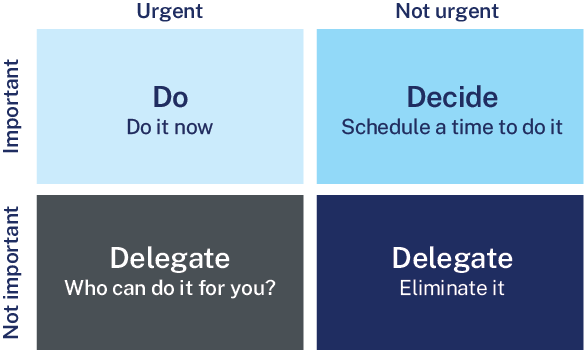
As well as identifying important and urgent tasks, it is helpful for a team to agree together which tasks need inputs or have dependencies on others, either within or outside the team; which tasks may be more complex and take longer to do; and what order they prefer to do them in. Where possible, managers should schedule tasks that are complex or that need help from others for times of the day (or times of a project) when workers are less likely to be fatigued and time pressured.
We all have our own working styles and preferences so, as far as possible, this needs to be balanced with giving workers reasonable job control so they can manage their own fatigue and stress.
The risk of psychological or physical harm will increase whenever there is a poor job to person fit or match. That is, the demands of the work don’t align with the worker’s knowledge, skill, ability, and work interests.
This is a reasonably foreseeable risk. Duty holders must design work, so far as reasonably practicable, to be free from risk to health and safety and then appropriately match available staff to the task. You must carefully consider the inherent requirements of the role. These are the essential duties, necessary knowledge, licenses, experience, and mental, emotional, and physical skills, a worker needs to perform the tasks safely and well. Reasonably accommodating peoples’ work interests and passions can be highly beneficial and increase motivation and engagement.
Remember some workers may be at higher risk from the same psychosocial and physical hazards due to:
Consult your workers to help identify who may be at greater risk, and what further work designs (so far as is reasonably practicable) you can put in place to manage risk for them.
You should also check that you consider the inherent requirements of the work, and work-person fit, during recruitment processes. You must comply with anti-discrimination legislation when you do this. Information and resources on this can be found at Anti-Discrimination New South Wales.
An organisation was finding it hard to recruit someone with an ideal work fit. To fill the position, they ended up appointing an inexperienced young worker who didn’t have all the skills and attributes the organisation was looking for.
The supervisor recognised this meant the worker and their teammates may therefore have increased psychosocial risks. To manage the situation, the supervisor made sure the worker did the general induction. Each day he met with the new staff member to go through the tasks and discuss the work priorities. The supervisor showed him how to operate the equipment but, because the worker did not speak English well, the supervisor was worried the worker might not really understand his instructions. The supervisor asked him to operate the equipment in front of him so he could check he was using it properly.
Over the next few weeks, the supervisor kept checking in and made sure he provided clear feedback when the worker needed to do things differently and praised him as his skills improved.
Before outlining how to use safe systems of work or administrative control measures to control psychosocial risks, it’s important to note they do not control hazards at the source. They rely on human behaviour, needing people to be effective supervisors and monitors. So, while they can help PCBUs minimise psychosocial risks, they are not reliable or effective on their own. If you use these as your main psychosocial risk control measure, you will not meet the required WHS standards.
As noted earlier, many different people in organisations may be involved in designing and/or managing systems of work, such as human resources staff, WHS teams and line managers. These groups of people must work together to design the systems of work and consult with affected workers while keeping WHS as their overriding priority.
Task rotation is a work procedure that aims to minimise risk by limiting the amount of time and/or number of times a worker is exposed to a hazard. It can be used as part of job control to allow workers to choose (within reason) the order they do tasks, to help reduce boredom and fatigue.
Another way to do task rotation is to have team members take turns doing the task. Managers can do this to give workers increased task variety and chances to use their skills (reducing workers’ boredom, helping them grow new skills and increasing ways of coping).
However, task rotation does not eliminate the underlying hazard. Workers will be exposed to the hazard, just for shorter periods. So task rotation should not be your organisation’s main control measure and ideally you should only use it as a short- term intervention until you can put better design solutions in place.
WHS rules, policies, and safe work procedures include acceptable workplace behaviours, working arrangements and conditions. To be effective, workers must know about them, find them beneficial, and use them. To achieve this, PCBUs must consult affected workers or their representatives when designing rules, policies, and procedures. You should also consult workers after they have been introduced to find out if they are still effective.
The rules, policies and procedures should:
If there are still risks to workers after a PCBU has put work design processes in place, you must tell your workers about them. You must also tell workers what control measures you have introduced and what they should do to make sure they and others are psychologically and physically healthy and safe. This includes giving them appropriately designed information, training (including required certificates to undertake the work), instruction and supervision as required by WHS Regulation (cl.55D(2)(i)).
The types of information, instruction, training, and supervision to give workers are noted below.
SafeWork NSW does not consider interventions that do not eliminate or minimise the psychosocial risk to be a sufficient psychosocial risk control measure. These can include mental health awareness (Employee Assistance Programs, mental health de-stigmatisation programs) and physical well-being programs (yoga, weight loss, gym, exercise, or healthy eating programs).
PCBUs must give personal protective equipment (PPE) to help control physical risks, where required. For example, workers may need to have personal duress or emergency alarms where there is a risk of assault or when working in remote locations, and adequate respiratory protective equipment when they are likely to be exposed to hazardous substances. Inadequate PPE may lead to an increase in stress and presents a risk to health and safety.
The term “reasonably practicable” refers to a standard that a PCBU is (or was at a particular time) reasonably able to do to ensure the health and safety of workers and others, while taking into account and weighing up all relevant matters (section 18 of the WHS Act). You must consider:
SafeWork NSW Inspectors consider whether an employer has or has not done all that they reasonably can to protect their workers’ health and safety.
SafeWork NSW expects that duty holders will always put in place the highest reasonably practicable level of risk control for affected workers. When duty holders are deciding what work design changes to make, you need to decide what is reasonably practicable in your circumstances.
To help you decide what is reasonably practicable, consider:
Only after you have assessed the size of the risk and effective ways to eliminate or minimise it can you think about the cost of putting controls in place. If the cost of a work design strategy is very disproportionate to the risks, it may be that using that design strategy is not reasonably practicable and therefore you do not need to use it. This does not mean that you do not need to take action to control the risk. You must use a less expensive way of minimising the risks instead. If two control measures provide the same level of protection and are equally reliable, you can use the less expensive option.
Remember you can’t guess the cost of a control measure. To be able to justify to a SafeWork NSW Inspector that the cost a control measure was not reasonable, you must have clear and valid evidence. Duty holders must be able to show an inspector, if asked, realistic calculations of the costs over the short and longer term to justify your decision.
Inspectors will not accept as a valid excuse that you did not know about the availability or cost of a control measure, in circumstances where you should know.
To check you have done everything that is reasonable to do, PCBUs must make sure you have carefully considered everything that may be relevant to managing the risks within your organisation. Duty holders should be able to show, if asked, how you made decisions and that these were based on sound information.
Putting work design and control measures in place changes the way people work. Organisations should test designs and other solutions with a representative group (or groups) to make sure they do what you intended, or if you need to change them further before you roll them out more widely. This piloting stage is also when duty holders can collect useful information on the likely ‘real cost’ of rolling out the changes. This can help you demonstrate what is or is not reasonably practicable and proportionate to the risk.
Before you authorise any new work designs, and put control measures in place, duty holders must do a final check for residual or new risks. To help you do this check, there is a suggested rating scale and outcomes noted below. Use it to check the adequacy of your control measures. They must be to at least level 2 and ideally level 1.
Remember that people-based controls, or administrative controls, are vulnerable. These are controls that rely on the skills, knowledge and experience of individuals and teams, including how they interpret your organisation’s rules. The reliability of these controls will depend on the degree to which they address the psychosocial risks, whether everyone acts on their new roles and responsibilities to manage these risks, and how skilled and trained the relevant workers are to apply the controls.
Work design, however, does not rely solely on people remembering and following policies and procedures. It is far more likely to be effective and sustainable.
For more information on tools to develop skills in designing work to improve psychosocial risk management see Work Design for Mental Health. The resources were commissioned by the NSW Centre for WHS research.
A guide to offer practical support for duty holders, including Persons Conducting a Business or Undertaking (PCBU) and Officers, to use work design to manage the risk of psychosocial hazards.
PCBUs must understand and manage the psychosocial risks in your organisation.
Psychosocial risks are most effectively and sustainably managed through better design of work and systems of work. To do this, PCBUs should make sure all staff making work design decisions:
Applying systems thinking to help identify psychosocial hazards and risks, and using work design to manage these, will mean you can control the risk closer to the source. As a result, you can provide the highest level of protection for the largest number of workers. You will also be protecting workers who may, for a range of reasons, be more vulnerable to harm from psychosocial risks.
As well as helping PCBUs understand and manage psychosocial risks, the approach and tools outlined in this guide can support you to comply with duties related to psychosocial hazards and risks under the WHS legislation.
A guide to offer practical support for duty holders, including Persons Conducting a Business or Undertaking (PCBU) and Officers, to use work design to manage the risk of psychosocial hazards.
The ‘Five Whys’ is a simple root cause analysis (RCA) technique that may help you understand how psychosocial hazards are interacting and combining to create a risk of harm. It can help duty holders to better understand the sources of psychosocial risk; approaches to design work; and systems of work to address the risk.
Step One: Clearly define the scope of the exercise and list each specific problem. The purpose of this is to get the team to focus on the same problem, which makes the process quicker and less confusing.
Step Two: Form a team to look at the problem and for solutions from different perspectives. Make sure you have workers who are experiencing the problem and who have some ‘expertise in the area’ where possible. It can be helpful to include workers from other areas or sites to get different perspectives. Appoint a trusted and competent person to facilitate the whole process and write down everyone’s answers.
Step Three: Organise the data you have about the problem with the help of the work team and clarify what you know about it. Creating a timeline of events that led to the problem emerging/risk can be very helpful. Remember for every risk, action/inaction and adverse behaviour included in the “timeline”, ask the question ‘what should have been done compared to what was done?’
Step Four: Ask ‘why’. Work backwards asking why the problem happened and write the answers down. Ask the ‘why’ question multiple times to help identify the causes that may have contributed to the risk.
Step Five: Once you have found the root cause(s) and assessed possible solutions, you can plan corrective action(s) or change(s) to help prevent it happening again. Make sure all workers are aware of the outcomes of the discovery process, and that they receive any appropriate training, instruction, and supervision on the changes and any new work methods.
Problem/situation: The call centre worker did not follow the organisation’s process to deal with an upset client, the client complained about how their issue was handled and worker was extremely distressed.
Doing a psychosocial task hazard analysis (PDF, 99.11 KB) will help you better understand the systems, essential resources (people, equipment, and information), and main steps you need to follow, in order to complete the task successfully and safely.
Psychosocial Task Hazard Analysis Tips
Workplaces and situations are always changing so any analysis is just at a point in time. It will increase your understanding of some of the current situations and hazards but is unlikely to be comprehensive. Use the information you have gained from the process and include it in your risk register to help you prioritise actions and make sure they get done and are monitored. Use the Task Hazard Analysis Template to assist you.
SafeWork NSW’s Code of Practice (pages 28-37) includes ten scenarios illustrating psychosocial risks and work design control measures. Case studies are included in the next section to illustrate organisational and team level work design, and team and task level work design.
Download example case studies which illustrate organisational and team level work design, and team and task level work design, and a Work Design Checklist as a PDF:
A busy, ageing, regional, local sport organisation has a bar, restaurant and gambling facilities associated with their club. It has extended opening hours, so staff need to do shift work and be able to move between the bar, restaurant, or gaming room depending on how busy each is. There is also a courtesy bus. Most customers on the courtesy bus are elderly and may require help to get on and off the bus.
These factors lead to regular customer complaints about bar and restaurant wait times. This is made worse as the poor stock ordering system means some favourite drinks and food frequently run out.
Club staff are expected to help create a friendly welcoming environment. However this is challenging when customers are often rude about wait times, intoxicated and young female staff frequently complain about being threatened and racially harassed. Frequent late roster changes are also creating problems for workers trying to plan childcare and home duties.
While no staff have recently put in a stress claim, the organisation is finding it hard to recruit and retain experienced staff as stressed and dissatisfied workers are easily employed by other clubs and restaurants in the town.
The club, through their worker consultation forums and exit interviews, identified a range of psychosocial and physical risks leading to staff stress and fatigue. These included: frequent exposure to harassment and aggression from customers, high workloads, emotionally demanding work (being polite to rude customers), low job control, hot working environments in kitchens, hazardous manual handling of kegs and food and drink supplies, unpredictable and inflexible shifts and inadequate training for new staff. They also identified that floor managers felt rushed so didn’t always feel they had enough time to give practical and emotional support.
The house and duty managers began to review daily takings, check online reviews, staff notes on issues that came up during their shifts, and upcoming functions to make sure they rostered enough experienced staff on when needed. Rosters were now published two weeks in advance and staff were encouraged to approach managers if they needed changes.
Instead of fixed roles, all staff were now expected and trained to do multiple roles across the club so they could help out whenever needed. To ensure staff were clear on the new responsibilities, this was included in their job descriptions. Staff suggested it would be helpful to have QR Code stickers (which took staff to an online version of the instructions), or quick reference sheets placed near the task. This was especially important where the task had to be done in a particular order for safety and efficiency reasons, such as tapping the kegs.
Staff said the varied roles made the shifts more interesting and they appreciated learning new skills. While staff were undergoing training some extra staff were needed. As they became confident the extra staff were no longer needed.
The ordering systems were reviewed and updated to make sure appropriate stock was available. Where it was not, floor staff could let customers know.
Most staff worked in teams of two or three and now at the beginning of each shift would meet to discuss how to divide tasks up to share the load. This improved their sense of job control, made work more interesting and junior staff were able to develop new skills.
Staff suggested that courtesy bus customers were more respectful when older rather than younger staff drove. Whenever possible, older staff were rostered on. This also allowed the staff to get to know their regular customers and build relationships. The bus was fitted with a radio in case the driver needed assistance or there was a medical emergency.
The club organised for staff representatives to meet with the architect and discuss the planned staged club refurbishment. This meant staff could help produce ideas to improve the workflow and reduce manual handling risks associated with the kitchen and bar areas. This also identified some quick fixes which were introduced immediately: co-locating ice and glassware; putting in floor mats to reduce leg fatigue; and making sure the heaviest food and drink supplies were in the middle shelves in the cool room and staff moved them using trolleys.
Staff were trained to politely ask customers about any service complaints but reminded and supported to use the club’s no abuse tolerance policy. If customers repeated the unacceptable behaviour the duty managers or security staff member escorted them off the premises.
A large regional supermarket chain has typical grocery items but also recently introduced an online sales and delivery service. To manage this, major rostering changes and a new computerised rostering system has been introduced. This new system sets the days and times when tasks need to be done. Staff are now expected to work across multiple store departments in a single shift. Managers make sure hours are equally distributed across available staff and the organisation’s roster app now requires staff to respond online with their shift availability.
The new rosters are based on this system with very little flexibility for changes at the local store level. Operating hours have also changed with the store now opening later and closing earlier. Some in-store departments have even more restricted operating hours. Customer self-service terminals have also been introduced.
The time allocations for tasks were recently updated based on the records of average times to complete standard tasks (where this information was available). A time and motion study was done for the new tasks. As a result, the time allowances either remained the same or were reduced. The new allowances have little flexibility and do not consider relevant circumstances, such as trying to do tasks during busy times when the store is crowded, and that customers frequently ask staff for help.
Limited worker consultation occurred about the changes before they were introduced. Staff report they now sometimes do not have enough time to complete tasks safely and well. This has led to stress and higher staff turnover. Supervisors have reported there are not enough experienced staff available to train new workers.
The supermarket, through their worker consultation forums and meetings with union representatives, identified a range of psychosocial and physical risks that were contributing to stress, fatigue and musculoskeletal risks. Concerns focused on:
Generally, staff reported they felt their supervisors did try to support them but did not have time as they too were often struggling to complete all their tasks. Staff felt store managers were not listening to their concerns.
Staff had significant concerns about the design of the new online order trolleys. These were larger with extra storage crates. While the larger size had reduced the number of ‘trips’ required, its size made it harder to see around (especially for shorter workers). The trolleys were generally heavier and harder to manoeuvre within aisles especially when the store was crowded.
Staff noted there were only ever a small number of staff rostered on in the alcohol department. Alcohol theft was a constant problem. They reported they were required to ask potentially underage customers for identification and to refuse service to those who were clearly intoxicated. This resulted in frequent abuse and threats of violence by customers.
Staff noted a range of design issues that made it stressful to monitor customers' safety. The supermarket was located close to the shopping centre’s entrance and there were two entry/exits. The sales counter was narrow which meant customers could easily reach across and take goods from behind the counter. While there was a panic alarm installed, it alerted a contact external to the shopping centre, so response times were slow and there were no safe retreat spots if workers were threatened.
The store manager heard about the concerns and reviewed the tasks, daily takings and consulted workers about the issues raised. As a result, some tasks have now been rostered for times when the store is less busy. This also helped reduce aisle congestion and customer complaints.
Local site managers have greater flexibility to change staff rostering from the predetermined settings. Managers can put staff in areas which best suit them and take into account workers’ skills, interests and personal circumstances. They now allow additional time to complete tasks when the store is busy. Staff have greater controls and can push back some tasks and do these later in the shift when it is not as busy.
Staff are being trained to work across multiple departments, but this is now done more slowly. Workers learn one area at a time and are allowed to master each one before moving to a new task. Training is now done during quieter periods when it is easier to concentrate. New workers are being given extra time to complete the tasks and paired with an experienced ‘buddy’. Workers report they feel better supported and have appreciated the greater job control.
Wherever possible more experienced workers are allocated to the alcohol department. Restocking is now done during quieter periods when there is less likely to be issues with intoxicated customers. During busy times and when there is a risk of customer aggression around refusing alcohol service, workers are required to stay behind the sales register area. This has been redesigned to be lockable with anti-jump wires to give workers a safe retreat place. Counters have been raised and widened with moveable objects (such as a donation jar) removed from the surface so these can’t be used as a weapon. All alcohol sales workers are provided with an earpiece connected to the supermarket store security team so they can discreetly call for assistance if needed. A panic alarm directly alerting supermarket and shopping centre security teams has also been provided. Centre security and the local police have increased their patrols around the liquor store and outside the supermarket. CCTV has been upgraded across the store and high price alcohol items placed in reinforced locked cabinets.
To allow for aisle congestion and interruptions from customers, the supermarket has allocated extra time to complete online picking orders, especially when there are customers in store. Workers are rotated through heavier pick aisles to reduce their exposure to manual handling.
The online trolley provider consulted workers about the design concerns. Modifications to the trolleys have reduced the quantity of products that can fit in each crate, reducing the overall weight and force required to move it. Staff use a smaller trolley with better visibility and handling characteristics during the busiest times. Where possible, bulky and heavy items such as dog food and drinks are now ‘picked’ directly from the truck or into crates when required.
Staff report they feel the workloads, in terms of time pressure and manual handling demands, are now more manageable and the increased job control has increased their ability to manage their fatigue and stress.
A morning administrative meeting has been introduced by senior leaders in a school. Workers must attend the meeting in addition to their current work requirements. Workers were not consulted prior to the announcement.
Workers emailed the principal with concerns about the process and additional workload. Workers felt that their workload had grown out of control, was impacting on their health and their family relationships, and the new imposed additional meeting was the ‘last straw’. One worker experienced an escalation in psychological distress and lodged a claim for workers compensation for a psychological injury.
The principal took immediate action to suspend the proposed new additional meeting so the executive could revisit the suggestion and review the existing meetings workers needed to attend in addition to their teaching duties. A confidential survey was also sent out to all affected staff so that their views could be considered. A range of psychosocial hazards and risks were identified through the review:
Following the review, the executive decided the additional morning administration meeting would go ahead beginning in the following term. This would allow staff to make childcare arrangements where necessary. Other meetings that were currently being held once a week would only occur on an as-needs basis, which would be determined by the affected staff.
Overall, the review showed that staff valued the concept of a whole staff weekly administration meeting, that had a clear start and finish time, an agenda circulated in advance, and opportunities for additional items to be raised. Workers said they did not believe they could manage this meeting without other requirements being reduced to fit it in. The principal set that in peak periods no meetings should be held at all, and any urgent administrative matters could be dealt with by email in those weeks.
At the educational department level, while conducting a regular review of incident reports, the People and Culture team noticed a spike in the number of claims for psychological injury. They also noted feedback from workers that too many work hours along with an intensification of work was contributing to many workers feeling burnt out. This trend was discussed at the senior executive level. The department issued advice to principals that they needed to consult with staff and consider staff members’ time when allocating work tasks and setting expectations.
A medium sized research organisation that does complex analysis for customers had a command and control management style with highly siloed specialist teams. The research topics and analyses that customers needed were highly varied. However, client requests always came with tight timeframes and significant reputational issues if the advice was inaccurate or late. The organisation had adopted hybrid working arrangements with most staff working some days in the week from home.
The organisation had topic specialist teams which often caused some teams to have too much work whilst other teams had too little. The IT workload system was antiquated and did not allow managers to properly understand project requirements or workloads, especially for complex policy matters. The organisation had poor tools and templates for routine analytic tasks and reports, even though better templates could have reduced team workloads.
Supervisors tried, where they could, to allocate routine tasks to non-specialist teams. However, this work was often boring and also resented by staff as they felt they missed out on developing and using interesting new skills. Staff were reporting stress and frustration around current work designs and systems of work, including role overload. The organisation was unable to rapidly respond to customer requests without putting their staff at risk of harm. The staff, especially managers, were feeling stressed and overwhelmed and knew things had to change. However, they felt a lot of anxiety about a proposed organisational restructure to address the psychosocial and efficiency risks.
A range of psychosocial risks were identified through the People at Work Survey, from staff consultation workshops and reports by supervisors to the management team meetings.
These included:
The organisation did a series of task analyses, used a workload planning tool to analyse workloads, and did a skills audit to better understand the organisation’s current needs and staff skills mix. Leaders used a participatory approach to design solutions, forming a working group made up of worker representatives and the management team.
Leaders put in place an organisational restructure. The new structure set up six work groups in which all members had basic generic analytic and reporting skills training. Each group also had at least one technical subject matter expert. This meant all groups could now do most tasks. Where additional technical advice was needed, the divisional manager would request the relevant expert from another team to join meetings to give specialist advice.
The organisation recognised that rather than outsourcing the development of a new IT workload system, analytical tools, and reporting templates, these should be developed internally and with staff input. External providers were unlikely to understand the nuances of the work tasks. An internal working group was set up and developed the new systems. The group advised the human resources team on how training for these should be rolled out to all staff.
The new IT system also allowed the leadership team and manager to monitor customer requests, workloads, staff leave, and so on. Leaders could flexibly allocate tasks to the teams that had the most capacity.
Project managers now held regular planning meetings with key staff and customers to make sure everyone had a clear understanding of the job scope, risks, and realistic delivery timetables.
The new IT system included collaborative workspace tools that allowed staff working from different locations to share data and run through analytical models on screen in team meetings.
All staff members received training and support to do general analytics work and reporting on tasks. Leaders used the skills audit to find out individual worker’s needs so training and support could be, so far as possible, individually tailored to them.
The changes were piloted, and results showed that, for most staff, while the workload peaks and troughs evened out, managers’ workloads had increased. Managers needed to change their leadership style to give practical and emotional support and guidance. This meant shifting to an inspirational mentoring role rather than the previous command and control model, which for some had been a struggle. The managers also needed to rapidly become skilled in the new workload management software so they could closely monitor task allocations. The pilot showed that the organisation needed more time to update the policies and procedures, including performance agreements. The senior leadership team acknowledged this and put in place bi-weekly meetings with all managers to give them greater emotional and practical support (such as helping prioritise tasks and delaying deliverables). The leadership team recognised managers’ flexibility and professionalism as they moved to different leadership styles and rewarded their long working hours and efforts with paid time off.
Senior leaders recognised the changes being made to the organisation’s design and culture were significant. As the new arrangements were being rolled out, they made clear staff should expect mistakes but know they offered valuable opportunities to learn and change the designs. Leaders made sure there was a culture where all members of the organisation could give feedback on elements of the design that were effective or may need further improvements.
Two years after the rollout, staff report workload peaks and troughs are more even; there are greater opportunities to use and develop skills; and they believe their organisation has an innovative learning culture and practices. Generally, stress is lower and staff satisfaction higher. Customer feedback shows the advice given by the organisation is of high quality and timely.
If a SafeWork NSW Inspector visits or calls, they will be checking that the PCBU and officers are meeting their duties to effectively manage psychosocial hazards and risks. While a SafeWork NSW Inspector will make inquiries, or conduct an investigation, based on the available information and work issues that have been raised, a SafeWork NSW Inspector may consider whether the PCBU and officers are carrying out the following:
SafeWork NSW has prepared a Work Design Checklist (PDF, 64.49 KB) to assist a PCBU and Officer to consider the information that may be required by the SafeWork NSW Inspector. However, this Work Design Checklist is for guidance purposes only. Importantly, a SafeWork NSW Inspector may ask a question, or request information, that is not included in the Work Design Checklist.